
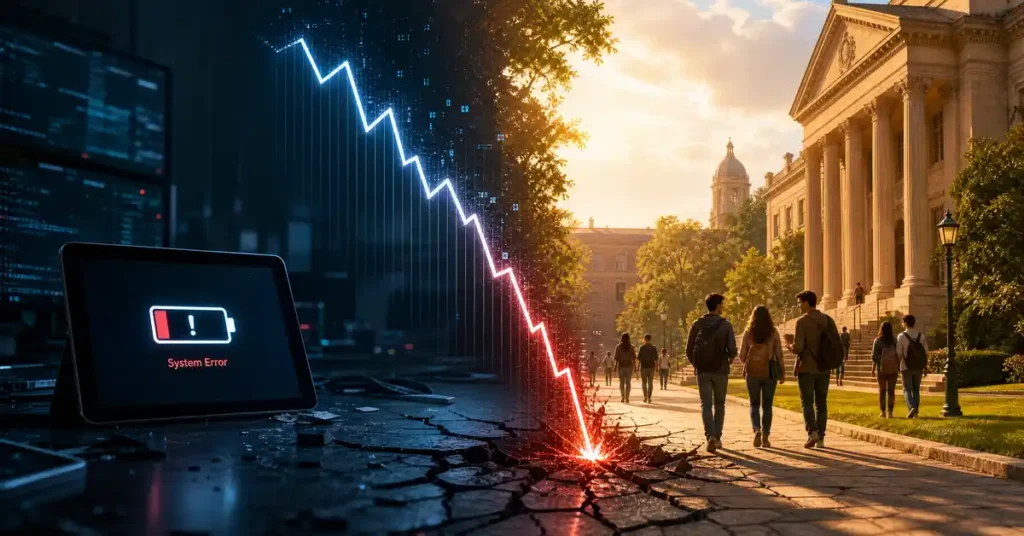
The “Digital Gold Rush” of education has officially hit a wall. In 2021, India was projected to become the “EdTech capital of the world,” with billions of dollars pouring into startups that promised to replace the traditional classroom with a smartphone screen. But as we move through 2026, the narrative has flipped. The industry that once boasted of “disrupting” education is now facing a staggering $100 billion valuation correction, and the most surprising trend of the year is the massive migration of students back to traditional, brick-and-mortar universities.
What went wrong? From the burst of the funding bubble to the “loneliness epidemic” of remote learning, here is the real story behind the great EdTech crisis of 2026.
1. The “Bubble Burst” by the Numbers
Between 2020 and 2021, Indian EdTech startups raised a record $4.73 billion in a single year . Fast forward to 2026, and that “unstoppable” growth has turned into a cautionary tale.
- Funding Plummet: Venture capital for EdTech dropped from nearly $5 billion at its peak to less than $300 million by the end of 2023 [1].
- Mass Layoffs: Over 30,000 employees have been laid off across major EdTech giants like BYJU’S, Unacademy, and Vedantu in the last three years [1].
- Valuation Reset: Companies once valued at $22 billion are now struggling to maintain a fraction of that worth, leading to what economists call the $100 Billion Correction in the global EdTech market.
2. The Hybrid Pivot: Why “Online Only” Failed
The biggest realization of 2026 is that pure online learning was a pandemic-era band-aid, not a permanent cure. Students and parents have discovered that a recorded video cannot replace a physical laboratory or a face-to-face mentor.
The “Vidyapeeth” Phenomenon
In a desperate bid to survive, even the biggest online players are now opening physical centers. PhysicsWallah invested heavily in its offline “Vidyapeeths,” while BYJU’S acquired the Aakash Institute chain to secure a physical footprint [1]. This “reverse-disruption” proves that the traditional university model was more resilient than the tech gurus predicted.
| Feature | EdTech (Online Only) | Traditional Offline University |
| Engagement | 15-20% completion rates for MOOCs [2]. | 85%+ graduation rates in physical programs. |
| Social Capital | Isolated screen time; no networking. | Peer-to-peer collaboration and networking. |
| Labs & Research | Virtual simulations only. | Real-world hands-on experience. |
3. The “Trust Deficit” and the Meritocracy Crisis
The recurring paper leaks and recruitment scandals of 2024-2026 (such as the NEET-UG 2026 crisis) have led to a massive trust deficit in digital systems. Students are rushing back to offline universities because they perceive them as “safer” environments with more transparent examination processes.
When exams are conducted in a controlled physical environment, the perceived risk of a “digital breach” is lower. For many Indian families, the risk of an online platform failing or a digital certificate being devalued is too high to ignore.
4. The Hidden Cost of “Cheap” Education
EdTech promised to make education affordable, but in 2026, students are realizing that “cheap” online certificates often lead to underemployment.
- The Skills Gap: Only 31% of online learners feel their experience adequately prepares them for the job market [2].
- Employer Preference: A 2026 survey of HR managers revealed that for entry-level roles, candidates with degrees from recognized offline universities are 40% more likely to be hired than those with only online certifications.
5. The Mental Health Toll: The “Screen Fatigue” Era
The psychological impact of remote learning has become a national talking point. “Screen fatigue” and the lack of social interaction have led to a spike in student anxiety and depression.
“A student’s worth cannot rest entirely upon one examination result or a digital rank. The campus life—the cafeteria debates, the sports field, the library silence—is essential for character building.” [3]
In 2026, students are choosing traditional universities not just for the degree, but for the community. The “loneliness epidemic” of the early 2020s has made the physical campus more valuable than ever.
India’s $5 Trillion Economy Goal: Can the Dream be Achieved by 2027?
6. What’s Next? The Rise of the “Phygital” Model
The EdTech crisis doesn’t mean technology is leaving education; it means it’s finding its proper place. The future is “Phygital”—a blend of physical infrastructure and digital tools.
- Governed AI: Universities are now using AI for instructional quality and administrative efficiency rather than replacing teachers [4].
- Infrastructure as a Priority: In 2026, the most successful universities are those that use high-speed 5G and VR labs within a physical campus setting.
Conclusion: The Great Realignment
The $100 Billion EdTech Crisis of 2026 is a “Great Realignment.” It marks the end of the era where we thought technology could solve every educational problem with an app. As students rush back to the hallowed halls of traditional universities, they aren’t rejecting the future—they are reclaiming the human element of learning.
The classroom isn’t dead; it’s just been upgraded.
How Smart Personal Financial Management Can Change Your Life in 2026