
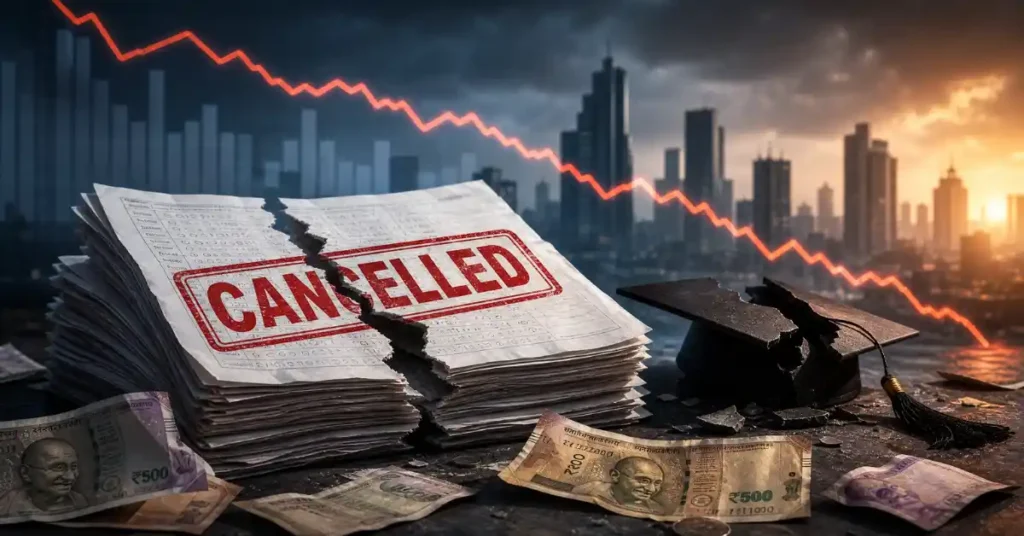
In May 2026, the silence in examination halls across India was shattered not by the scratching of pens, but by the notification pings of a national crisis. The cancellation of the NEET-UG 2026 exam on May 3, following widespread allegations of a paper leak, has done more than just delay the dreams of 2.3 million aspiring doctors. It has exposed a multi-billion dollar economic sinkhole that threatens to swallow India’s educational future.
While the emotional toll on students is immeasurable, the economic cost of paper leaks is a cold, hard reality that impacts everyone from the poorest rural farmer to the national exchequer. In 2026, we are witnessing the “Paper Leak Economy” reach a breaking point.
1. The Direct Financial Drain on Students and Families
For an Indian middle-class family, preparing for a national entrance exam like NEET or JEE is a massive financial investment. When an exam is cancelled, that investment doesn’t just stall—it often evaporates.
The Coaching Hub Crisis
In hubs like Kota and Sikar, parents spend between ₹2 lakh to ₹5 lakh annually on coaching fees, hostel accommodation, and living expenses. A cancellation means:
- Extended Stays: Students must stay in hostels for additional months awaiting re-exams, adding ₹15,000–₹25,000 per month in unplanned costs.
- The “Drop Year” Tax: For many, 2026 was their “drop year.” A delay or cancellation often forces a second drop year, doubling the total cost of entry into professional education.
2.Travel and Logistics
On May 3, 2026, over 23 lakh students traveled to thousands of centers. Many traveled from rural villages to district headquarters, spending money on trains, buses, and overnight hotels. With the exam scrapped, that money—estimated at over ₹400 crore nationally—is gone, with no refund for the logistics of a “failed” attempt.
2. The Government’s Massive “Waste” Bill
Conducting a national-level exam in a country of 1.4 billion people is a logistical feat comparable to a general election. The National Testing Agency (NTA) and state boards invest thousands of crores into:
- Security Infrastructure: GPS-tracked papers, biometric verification, and AI-monitored CCTV.
- Personnel: Hundreds of thousands of invigilators, security personnel, and observers are paid for their time.
- Printing and Distribution: Millions of high-security question papers are printed and transported in armored vehicles.
When an exam is cancelled, the entire expenditure for that day is a 100% loss. Experts estimate that the cost of re-conducting a single national-level exam like NEET-UG 2026 could exceed ₹1,000 crore, a burden ultimately borne by the Indian taxpayer.
3. The Shadow Economy: The Rise of the “Paper Mafia”
Perhaps the most disturbing economic aspect is the growth of a shadow economy. Investigations into the 2026 leaks revealed a sophisticated “Paper Mafia” operating across state lines.
| Metric | Estimated 2026 Impact |
| Leak Price Tag | Leaked papers sold for ₹30 lakh to ₹50 lakh per candidate. |
| Organized Crime | Multi-state networks involving middlemen, coaching insiders, and tech experts. |
| Money Laundering | Use of Telegram and encrypted apps to move untraceable funds. |
This shadow economy doesn’t just steal seats; it “demonetizes” the hard work of honest students. When merit is for sale, the value of a degree drops, leading to a long-term competence crisis in critical sectors like healthcare.
4. The Opportunity Cost: A Stalled Workforce
The economic impact of paper leaks isn’t just about immediate spending; it’s about the delay in human capital.
India’s healthcare system is already strained. A one-month delay in NEET results means a one-month delay in the graduation of 100,000 future doctors five years from now. When multiplied by the frequency of leaks across various sectors—SSC, Banking, Railways—the cumulative delay in young professionals entering the workforce costs the Indian GDP thousands of crores in lost productivity.
5. The Erosion of “Educational Trust”
In economics, trust is a form of capital. India has long prided itself on its meritocratic entrance exams as a tool for upward mobility.
- Brain Drain: The 2026 crisis is fueling a new wave of “Educational Brain Drain.” Families who can afford it are increasingly looking at expensive private universities abroad (Russia, Uzbekistan, or the West) rather than risking the uncertainty of the Indian public exam system.
- Investment Hesitation: Private investors in the EdTech and higher education sectors are becoming wary of the systemic instability caused by recurring leaks.
6. The 2027 Pivot: The Cost of Reform
The government has announced a mandatory shift to Computer-Based Testing (CBT) and “On-Center Printing” from 2027 to curb physical leaks. While necessary, this transition comes with its own massive economic price tag:
- Infrastructure Spend: Thousands of new secure testing centers must be built or leased.
- Digital Divide: There is a significant cost in ensuring that rural students have the same access and training for digital exams as their urban counterparts.
How Smart Personal Financial Management Can Change Your Life in 2026
Conclusion: The Price of a Fair Future
The economic cost of paper leaks in 2026 is a wake-up call. It’s not just about a “spoiled” exam; it’s about the erosion of India’s most valuable resource: its youth. For every leaked paper, a family loses its savings, the government loses its revenue, and the nation loses its credibility.
As we look toward 2027, the goal isn’t just to make exams “leak-proof”—it’s to make the Indian educational economy resilient. Until the cost of corruption is made higher than the profit of a leak, the Indian student will continue to pay the ultimate price.
Certificate for Project 10 Sample Certificate Templates, Tips and Structure