
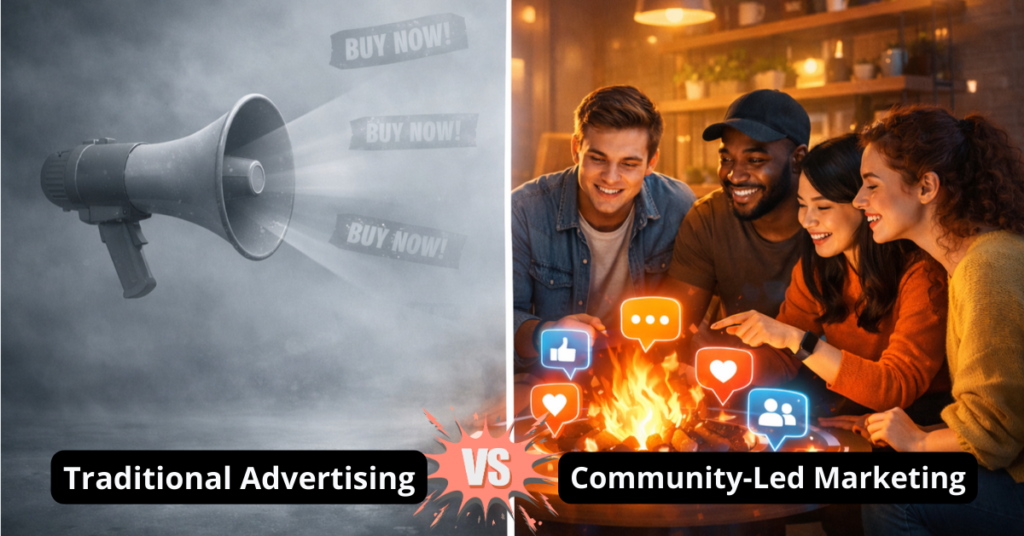
For over 100 years, the formula for business success has been simple: spend money on marketing, make money from sales. As we enter 2026-2027, that formula is fundamentally broken. If a company’s success relies on Traditional Marketing, where customers are targeted through ads that interrupt a video they’re watching, or through ads that are placed on social media, that business is in trouble.
The industry is quickly realizing that the future of marketing lies in Community-Led Marketing. This takes a protective case from BBA and MBA students, entering the job market this year. Prioritize this new Community-Led Marketing shift, as the winning brands in 2026 are not the ones that overspend on advertising, but the ones with the most active and loyal customers.
1. The Data Doesn’t Lie: The Decline of the ‘Interruptive’ Model
Reports from the advertising industry in 2026 show that traditional marketing is in fact ‘dying’. This is the case even though the underlying metric, advertising spend, does show some increase. Despite the increasing spending, it is evident that returns from advertising are in decline.
• Positive returns in advertising are a thing of the past: a staggering 74% of Gen Z and Millenial consumers make use of some combination of sophisticated advertising obfuscation, sponsored content blockers, and advertisement removal filters.
• The Trust Deficit: Analyzing data from a 2026 HubSpot report, a mere 12% of customers expressed trust for paid advertisements from brands, while 88% expressed trust for advertisements from other users within their communities.
• The AI Impact: AI-based search engines, including Perplexity and SearchGPT, are ignoring paid advertisements to deliver direct responses from peers.
When it comes to marketing, 2026 and beyond should center around “belonging” instead of “broadcasting.”
2. What is Community-Led Marketing (CLM)?
Imagine traditional marketing like a megaphone; Community-Led Marketing is like a campfire. It is a method where a company prioritizes its community to center its expansion, product development, and marketing efforts.
In CLM, the community isn’t merely a target audience; they’re co-creators.
• For example, a skincare brand in 2026 would not run advertisements; instead, it will create exclusive Discord or WhatsApp groups in which 5,000 “super-users” poll to decide which new active ingredients should be added, and to whom these products should be distributed for testing prior to the launch. These consumers then become the brand’s most powerful (and cheapest) marketing machine.
3. Why ‘Belonging’ Beats ‘Buying’ in 2026
The community-centric marketing shift is a response to the digital loneliness of the mid-2020s – Consumers are yearning for a genuine connection.
A. Reduced Customer Acquisition Cost (CAC)
In 2026, the cost of advertising on platforms like Facebook has never been more expensive. However, brands that use community-building strategies have CAC that is 40-60% lower because their community members perform the marketing for them.
B. Increased Customer Lifetime Value (LTV)
Advertisement-directed customers are called “transactions.” Community members are not “transactions” but rather “vipers.” They remain part of the community for extended periods, spend more money, and are less likely to migrate to competitors for a better deal.
C. Feedback Loop
Community-led brands do not have to pay to collect customer feedback to direct their marketing. They know what the customers want because they are in direct communication on a daily basis.
The Netflix Strategy: How a DVD Rental Store Became a Global Streaming Giant
4. How to Build a Community-Led Strategy
Business students need to shift their thinking in the chains of selling to thinking in the chains of stewardship. These are the leaders in this thinking in 2026:
1 Identify the Shared Struggle. What is the problem in the audience but they are not able to solve it by themselves? (for example, a fitness brand that builds a community around ‘lonely marathon training’).
2. Select a ‘Third Space’ Other than Social Media. Consider using Discord, Circle, or private subreddits which can host more meaningful exchanges.
3. ‘Champions’ Needs to be Empowered. Identify the top 1% most engaged members of your community and provide them with special privileges, early access, and direct communication with the CEO.
Frequently Asked Questions (FAQs)
Is traditional advertising completely dead?
Not completely, but its role has changed. In 2026, traditional ads are used for awareness, while community-led marketing handles conversion and retention. You can’t build a sustainable business on ads alone anymore.
How is Community-Led Marketing different from Influencer Marketing?
Influencer marketing is still a “one-to-many” broadcast. Community-led marketing is “many-to-many.” It’s about the relationships between members of the community, not just their relationship with a single influencer or the brand.
Can small businesses afford Community-Led Marketing?
Yes! In fact, it’s easier for small businesses. You don’t need a million-dollar ad budget to start a WhatsApp group or a local meetup. CLM is about time and empathy, not just money.
What skills do I need for a career in Community-Led Marketing?
You need a mix of Psychology, Data Analytics, and Content Creation. You need to understand what makes people feel like they belong, while also being able to track how that belonging translates into business growth.
For more 2026 marketing trends and BBA career guides, explore bbaproject.in.