
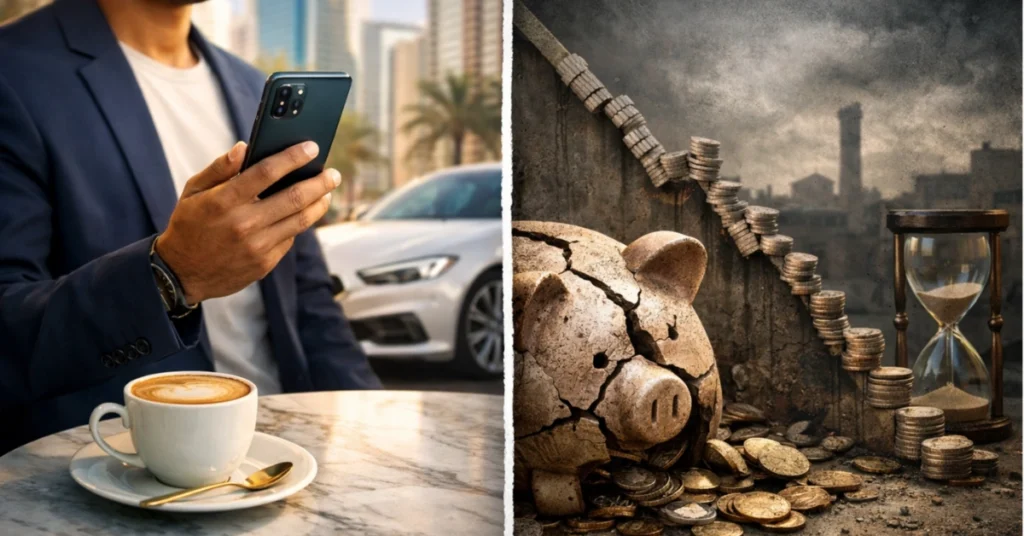
A worrying trend is emerging in India’s cities and towns in early 2026. On the one hand, you have a generation of young professionals who sip overpriced coffee, buy the latest iPhone models every few months on a no-cost EMI, and premium cars. On the other hand, the Reserve Bank of India (RBI) is warning about savings hitting a 50 year low.
Consumers of India’s middle class paradoxically kept their spending on high-value, perceptually wealthy, and apparently luxurious objects, while in reality the ‘wealth’ and ‘luxury’ are emanating from an ever-increasing burden of debt and debt servicing.
1. The End of Traditional Saving Methods: A Record Low After 47 Years
For years, India’s households were the backbone of the economy. Their abnormally high saving rates would be directly funnelled into investments, thus driving the economy. But recent records from RBI show that net savings from households plummetted to an alarming 5.1% of GDP, the lowest in 47 years. Coupled with this is an alarming rise in household debt.
So, on what exactly is all this household money being spent on? The answer: debt and other discretionary high-ticket items.
2. The Great Indian Upgrade: The Premiumization Phenomenon
At the core of this spending spree is an emerging cultural phenomenon called “premiumization”. It refers to the economy’s shift to a higher-spending equilibrium as a result of consumers’ willingness to spend more on new, high-quality, and life-enhancing products.
• The Smartphone Effect: A mobile phone was a simple tool a decade ago. Now, the iPhone is a status symbol. After all, a phone on finance is just as good as a phone on cash.
Rising D2C Brands: D2C or direct-to-consumer brands sell more than a product. They sell a lifestyle using different platforms. They have become social media experts creating hype for their consumers to buy the product.
Experience Economy: the middle class is spending more on services such as travel, dining, and entertainment what the people do during this time is give themselves the experience as opposed to one time purchase goods. While the experience is beneficial, many people do it through credits.
Premium products and services, regardless of economic uncertainty, remain in demand. The World Economic Forum said in a report, by 2030 93% of spending in the developing economies will come from the affluents and middle class Indian consumers.
Iran-Israel Conflict: 5 Critical Economic Threats to India in 2026
3. The Easy Credit Trap: BNPL and the No-Cost EMI Illusion
The availability of easy credit is evident in the wildfire of spending. The illusion of being financially able to buy expensive things, is caused by trick purchasing options like BNPL (buy now, pay later) and “no-cost” payment options. These are payment methods that offer flexibility but are designed to provide a false sense of wealth.
Analysis conducted recently shows that growing household debt is occurring twice as fast as new household assets. The middle class is in fact losing their monetary savings resources. For every one rupee that they save as assets, two rupees in debt are incurred.
This shows how fundamentally the attitudes in the society are changing. The saving mentality is being replaced with the spending one. It is worrying how this new society of ‘pay later’ is destabilizing the finances of millions.
4. The Inflation Squeeze: When Your Raise Isn’t a Raise
The problem is exponentially increasing with the prevailing inflation. The cost of living in cities and towns is increasing more than the rise in wages.
This leads to a psychological need where spending to survive is paramount, even if saving and incurring debt is a necessity. The need to survive is driving most households to the edge of financial bankruptcy.
5. The Way Forward: A Call for Financial Literacy
The ‘Rich-Poor’ Paradox is also a cultural issue and notJust economic. One solution that works is stopping the shame cycle and starting the promotion of a different type of financial literacy that works for the 2026 economy.
There is a clear opportunity for the next wave of financial instruments and services. This is the paradox of the insufficient demand for debt management, saving, and spending decision tools. Companies that address this paradox will not only be successful, but will also be instrumental in the dependent economy of India’s middle class.
India’s $5 Trillion Economy Goal: Can the Dream be Achieved by 2027?
Conclusion
The India consumer economy is still developing and the next business leaders, along with professionals of many disciplines, will have a large financial, economic, and business puzzle to solve. The glimmer in the Indian economy will show the world its potential.
👨💼 Author: BBAProject Editorial Team
✍️ The BBAProject Editorial Team comprises business graduates and educators dedicated to creating practical, syllabus-based learning resources for BBA students.
⚠️ Please Note: Articles published on BBAProject.in are well-researched and regularly updated. However, students are advised to verify data, statistics, or references before using them for academic submissions.