
The world of hiring has changed forever. If you’re applying for a job in 2026, your first interview isn’t with a person—it’s with an algorithm. The traditional method of a hiring manager reading through a stack of resumes is a thing of the past. Today, it’s estimated that over 90% of Fortune 500 companies rely on Artificial Intelligence (AI) to screen and filter candidates long before a human sees their application. This shift towards “Automated Hiring” is driven by one primary goal: efficiency. Companies need to sort through thousands of applications quickly, but this raises a critical question: are we losing empathy in the process?
The Tech Behind the Screen: Key AI Tools
To understand modern recruitment, you need to know the technology that powers it. These aren’t just simple keyword scanners anymore; they are sophisticated systems designed to analyze every aspect of a candidate’s profile.
- ATS Evolution (Applicant Tracking Systems): Platforms like Workday and Oracle Taleo are the backbone of modern HR departments. These systems have evolved far beyond simple databases. They now use Natural Language Processing (NLP) to understand the context of your resume, not just keywords. An advanced ATS can identify your skills, analyze your years of experience, and rank you against other applicants based on the job description.
- AI Video Assessment: Companies are increasingly using tools like HireVue for initial interviews. In these interviews, you record your answers to preset questions. The AI then analyzes your responses, including your facial expressions, eye contact, and tone of voice, to assess your soft skills, such as confidence and enthusiasm.
- Gamified Recruitment: To look beyond resumes, companies like Pymetrics use a series of neuroscience-based games. These games measure inherent traits like your attention to detail, risk tolerance, and problem-solving abilities. The platform then matches your cognitive and emotional profile to the traits of a company’s top performers in a specific role, suggesting a potential fit without traditional resume bias.
AI Bias vs. Efficiency
While AI promises to make hiring more efficient and objective, it has a significant flaw: it can be biased. An AI is only as good as the data it’s trained on. If the historical hiring data used to train the algorithm reflects past biases, the AI will learn and amplify them. A famous example is Amazon’s experimental recruitment tool, which had to be scrapped because it learned to penalize resumes that included the word “women’s” and downgraded graduates from all-women’s colleges.
To combat this, governments are stepping in. Regulations like the New York City AI Bias Law now require companies to conduct independent audits of their automated hiring tools to ensure they are not discriminatory. By 2026, such transparency laws are becoming more common, forcing companies to be more accountable for the fairness of their algorithms.
How to Beat the Bot: Staying Hirable in an AI World
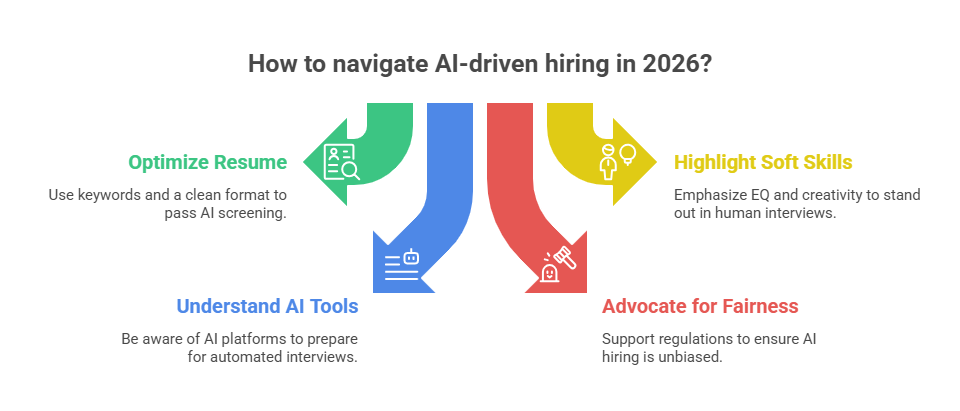
In this new landscape, job seekers need a new strategy. The goal is no longer just to impress a human reader but to first pass the AI filter. Here’s how you can stay hirable:
- Keyword Optimization: Read the job description carefully and use the specific terminology and keywords mentioned. The AI is programmed to look for these phrases. If the description asks for “project management experience,” make sure those exact words are in your resume.
- Formatting for Bots: Keep your resume clean and simple. Avoid using complex tables, columns, graphics, or unusual fonts. While they may look visually appealing to a human, they can confuse an ATS, causing it to misread or ignore important information. A straightforward, chronological format is the safest bet.
- Soft Skills Supremacy: While AI can analyze data and keywords, it cannot yet truly replicate or measure human qualities like emotional intelligence (EQ), creativity, and critical thinking. Highlight these skills in your interviews and on your resume. These are the qualities that will set you apart in the final, human-led stages of the hiring process.
Quiet Quitting: The Gen Z Revolution Redefining HRM in 2026
The Human-in-the-Loop Concept
Despite the rise of AI, the human element is not disappearing—it’s just shifting. The future of recruitment is a “Hybrid Hiring” model. In this model, AI does the heavy lifting by handling the high volume of initial applications and screening for basic qualifications. This frees up human recruiters to focus on what they do best: assessing culture fit, conducting in-depth interviews, and making the final, nuanced decision. The final choice to hire someone still belongs to a human, who can evaluate a candidate’s personality and potential in a way an algorithm cannot.
Frequently Asked Questions (FAQ)
- Q1: Can AI read my PDF resume?
- Ans: Most modern ATS can parse PDF files correctly. However, to be completely safe, a plain text (.txt) or Microsoft Word (.docx) version is still the most reliable format to ensure all your information is read accurately.
- Q2: Is AI hiring legal?
- Ans: Yes, it is legal. However, with new laws emerging in 2026, companies are now required to be transparent about their use of AI in hiring and must ensure their tools are not discriminatory.
- Q3: How do I know if a company is using AI to interview me?
- Ans: The interview invitation will usually give it away. Look for mentions of third-party platforms like HireVue, Pymetrics, or Mya. These are clear indicators that an automated system will be involved in your assessment.
Conclusion
AI in recruitment is not a temporary trend; it is the new standard. It acts as a filter, designed to bring the most qualified candidates to the forefront. For job seekers, the key is not to fear this technology but to understand it. By learning how to optimize your application for algorithms and focusing on the human skills that AI cannot replicate, you can navigate the modern hiring landscape and successfully land your next job. The gatekeeper may be an algorithm, but the key to unlocking the gate is still in your hands.
Team Dynamics and Motivation: Building High-Performing and Inspired Workforces
👨💼 Author: BBAProject Editorial Team
✍️ The BBAProject Editorial Team comprises business graduates and educators dedicated to creating practical, syllabus-based learning resources for BBA students.
⚠️ Please Note: Articles published on BBAProject.in are well-researched and regularly updated. However, students are advised to verify data, statistics, or references before using them for academic submissions.