
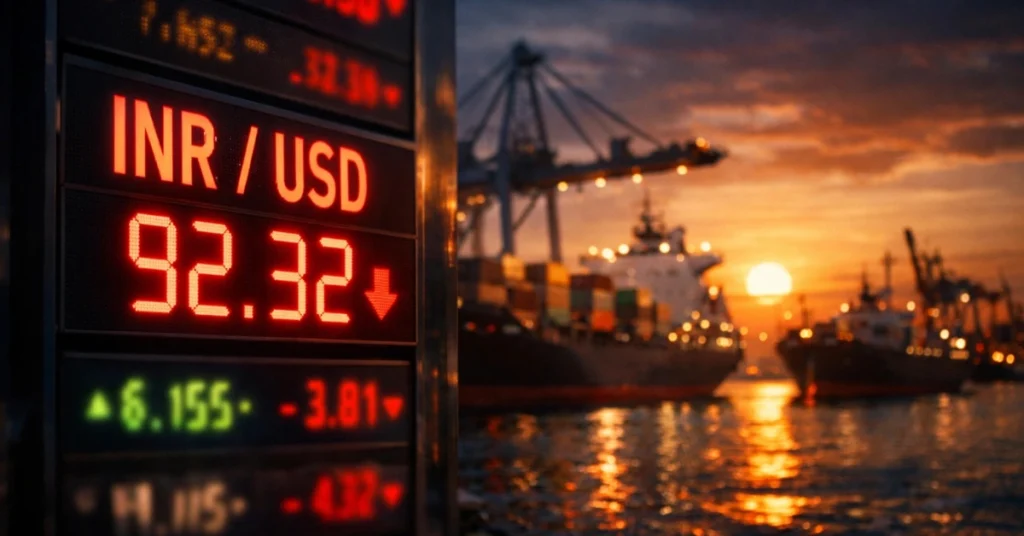
The ₹92 Milestone: A New Low for the Indian Rupee
The Indian Rupee breached another milestone on March 12, 2026, reaching ₹92.32 to 1 U.S. Dollar. The depreciation of the Indian Rupee was almost expected given the continued depreciation of the Rupee all through 2025. The decrease of the Rupee to ₹92, however, has been shocking to the Indian economy. The depreciation of the Indian Rupee is caused by the increasing tensions in the Middle East and rising global crude oil prices. The depreciation of the Rupee is an indicator of the Indian economy and the balance sheets of Indian businesses will be severely affected by this in 2026.
Now imagine a world where the prices of all goods and services are increasing. The world is in a state of war and prices are rising due to imported inflation. The war has resulted in an increase of the crude oil prices which causes the increase in the prices of goods and services. March 2026 is a month when the Indian will be experiencing imported inflation. This article seeks to explain the reasons behind the new low record of the Indian Rupee which is in record low and the increase in cost of living which Indian businesses will benefit from and which businesses will lose.
Also Check : Nifty at 23,800: Why the Indian Stock Market is Volatile in March 2026 and What Investors Should Do
Why is the Rupee Falling? The “Oil & Conflict” Connection
Although the rupee has fallen to the value of ₹92, the root cause of the problem lies more in external factors, not in the internal economic systems of India. This is because the country still has a decent GDP growth of 7.4%. The following has created a proverbial perfect storm with the above-mentioned values of the rupee:
- Surging Crude Oil Prices: With crude oil prices hovering around $110-$115 per barrel due to the U.S.-Israel-Iran war, India’s oil import bill is projected to rise by $56–$64 billion annually [15].
- Global Risk-Off Sentiment: Geopolitical uncertainty has led foreign investors to pull capital out of emerging markets like India and move it into “safe-haven” assets like the U.S. Dollar and Gold [2] [5].
- FII Outflows: Heavy selling by Foreign Institutional Investors (FIIs) in the Indian equity markets has increased the demand for Dollars, further weakening the Rupee [3] [8].
The Silent Killer: What is “Imported Inflation”?
A direct effect of the rupee dropping to ₹92 is Imported Inflation. An average Indian consumer and business will immediately feel the effect of Imported Inflation. A weaker rupee will increase the price of goods India imports (i.e. crude oil and electronic components). This is an important matter to consider because India imports a high percentage of crude oil.
The Economic Impact in Numbers:
- Inflation Spike: Estimates suggest that every 10% rise in crude oil prices can raise WPI inflation by 80-100 bps and CPI inflation by 40-60 bps.
- Rising Import Costs: India may face a $7–8 billion higher monthly import bill due to the current crude surge and currency depreciation.
Impact on Indian Businesses: Winners and Losers
A weaker Rupee creates a divided landscape in the Indian corporate sector. While some industries are struggling with rising costs, others are seeing a significant boost in their margins.
| Sector | Impact | Why? |
| IT & Software Services | Winner | Earn in Dollars, spend in Rupees. A 1% fall in the Rupee can boost IT revenues by 0.5% and margins by 10-20 bps [11]. |
| Aviation & Logistics | Loser | Fuel costs (ATF) are dollar-linked. Rising oil + weak Rupee = massive pressure on bottom lines. |
| Pharma (Exports) | Winner | Indian pharma companies with high export exposure to the US and Europe will see higher realization in Rupee terms [10]. |
| Electronics & Autos | Loser | High dependence on imported chips and components makes production more expensive, leading to price hikes for consumers. |
| Textiles | Winner | Export-oriented textile hubs like Tirupur and Ludhiana become more competitive in the global market [10]. |
What Should Businesses and Investors Do?
As the Rupee stabilizes at these new levels, Indian businesses must shift their strategies to navigate the “Imported Inflation” era:
- Hedging Currency Risk: Businesses with high import requirements should use forward contracts and options to lock in exchange rates and avoid further volatility.
- Focus on Localization: For manufacturers, the ₹92 Rupee is a strong signal to accelerate “Make in India” initiatives and reduce dependence on imported components.
- Investor Strategy: Investors should look at export-heavy sectors like IT and Pharma as a natural hedge against Rupee depreciation in their portfolios.
Conclusion: The New Normal for 2026
The Rupee at ₹92 is indicative of a volatile global scenario. The challenges that come with imported inflation are counterbalanced by the competitive advantage it provides to India’s service and export sectors. For BBA students and business professionals, navigating this complexity is imperative in 2026. The “cheap dollar” era has come to an end. The “Strategic Exporter” is the new paradigm.
Why Middle-Class Indians Feel Poorer Despite Higher Income
References: [1] Reuters – UBS cuts Indian rupee March forecast to 92: https://www.reuters.com/world/india/ubs-cuts-indian-rupee-march-forecast-92-2026-01-07/ [2] Trade Brains – 4 Reasons Why INR Slipped Below 92: https://tradebrains.in/4-reasons-why-inr-slipped-below-92-per-dollar-again/ [3] Firstpost – Rupee depreciated to 92.32 against USD: https://www.facebook.com/firstpostin/posts/1439478221546494/ [4] Economic Times – Rupee may slide past 92 as Mideast war fires up oil: https://m.economictimes.com/markets/forex/rupee-may-slide-past-92-vs-usd-to-record-low-as-mideast-war-fires-up-oil-prices/articleshow/129003054.cms [5] Financial Express – 3 reasons why the rupee is falling today: https://www.financialexpress.com/market/3-reasons-why-the-rupee-is-falling-today-hits-fresh-2026-lows-trading-below-92-per-dollarnbspnbsp-4162100/ [6] Instagram – Indian Rupee tumbled to fresh all-time low crossing 92: https://www.instagram.com/p/DVsuBU8APTv/ [7] CNBC – Asia’s worst-performing currency set for rocky start to 2026: https://www.cnbc.com/2025/12/22/asia-worst-performing-currency-rupee-trade-deal-outflows.html [8] Reuters – Indian rupee enters 2026 on the back foot: https://www.reuters.com/world/india/indian-rupee-enters-2026-back-foot-after-worst-annual-drop-three-years-2025-12-31/ [9] Economic Times – Economic Survey 2026 Rupee punching below weight: https://m.economictimes.com/news/economy/indicators/economic-survey-2026-rupee-punching-below-its-weight-but-why-it-does-not-hurt/articleshow/127762019.cms [10] Value Research – Rupee falling further in 2026? 7 sectors that benefit: https://www.valueresearchonline.com/stories/227747/rupee-falling-further-2026-7-sectors-that-can-benefit/ [11] New Indian Express – Weaker rupee boosts IT revenues by up to 6%: https://www.newindianexpress.com/business/2026/Jan/26/weaker-rupee-boosts-it-revenues-by-up-to-6-in-fy26-supports-margins [12] Economic Times – India face $7-8 billion higher monthly import bill: https://m.economictimes.com/news/economy/indicators/india-may-face-78-billion-higher-monthly-import-bill-as-crude-surges/articleshow/129342655.cms [13] Dhan – Impact of rising crude oil prices in March 2026: https://dhan.co/blog/news/rising-crude-oil-prices-march-2026/ [14] Reuters – India says oil price surge unlikely to stoke inflation: https://www.reuters.com/world/india/india-says-oil-price-surge-unlikely-stoke-inflation-sharply-2026-03-09/ [15] Business Standard – Crude at $115 per barrel raise India oil import bill: https://www.business-standard.com/economy/news/crude-115-per-barrel-could-raise-india-oil-import-bill-64-bn-126030900720_1.html
👨💼 Author: BBAProject Editorial Team
✍️ The BBAProject Editorial Team comprises business graduates and educators dedicated to creating practical, syllabus-based learning resources for BBA students.
⚠️ Please Note: Articles published on BBAProject.in are well-researched and regularly updated. However, students are advised to verify data, statistics, or references before using them for academic submissions.