
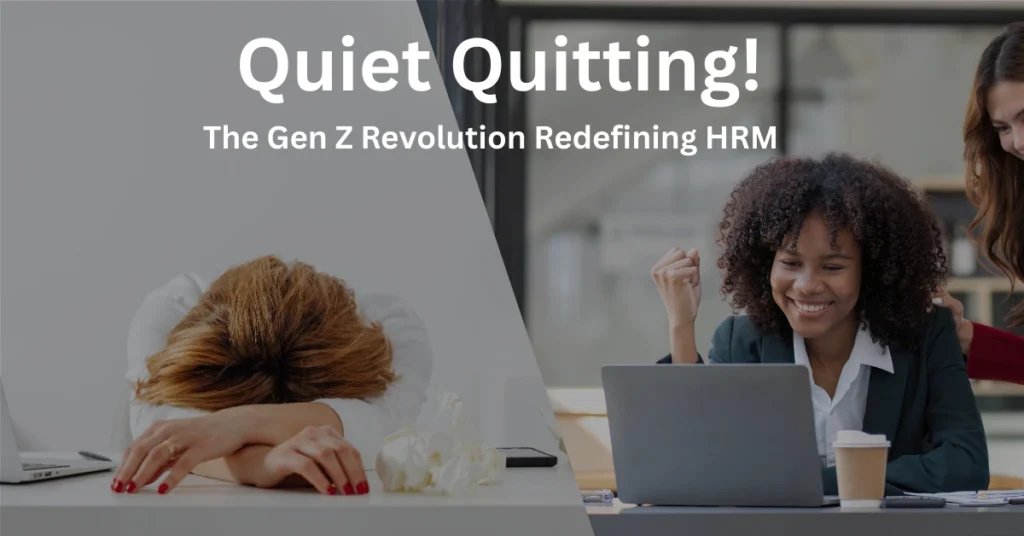
The era of “hustle culture” is starting to fade. The professional world used to be dominated by the idea of going the “extra mile” with working late hours, and dealing with an endless portion of work. But a powerful counter-movement is being embraced, especially among the younger workforce, and it is called “quiet quitting.” Contrary to what the name implies, “quiet quitting” does not mean employees are about to walk out of work. Rather, quiet quitting is the decision to stop going above and beyond and to only work the hours that are stated in their contract. They are distinguishing their personal time from company time. This is a trend that is rapidly spreading across social media, especially on TikTok, and is changing the dynamics of work relationships by leaving behind a culture of transactional loyalty and entering a much more sustainable and respectful world of work.
Quiet Quitting vs. Traditional Work Ethic
Baby Boomers and Gen X focus on work differently than Gen Z. For previous generations, a central work ethic comprised of devotion to the company, and work done above and beyond the hours contracted. Unlike previous generations, Gen Z prioritizes their personal interests outside work. Quitting a job may indict someone as lazy or unfocused in the eyes of older generations. However, Gen Z views employment as a transaction where beyond the contractual obligations do not merit work efforts. Reducing work efforts to what is minimally required is neither underperformance, nor unambitious. It is a response to workplaces that, in spite of their demands, offer little. Quitting a job is not a sign of structural burnout, but a self-preserving strategy to protect one’s mental health.
Why Gen Z is Leading the Movement?
Several converging factors have positioned Gen Z at the forefront of the quiet quitting movement:
- Burnout and Stress are Primary Reasons: Growing up during the 2008 recession and the COVID pandemic has caused a heightened awareness and concern for mental health for Gen Z. They are the most advocated generation for mental health, with many feeling that being burnt out from work, and/or having stress from work, should never be a reality. They view self-preserving mental health boundaries, as a priority. A large portion of the Gen Z workforce have stated that a job that provides mental health support, and a good work life balance is a job that is more valuable than one with a higher pay.
- Stagnant Wages and Lack of Growth: Today’s young workers increasingly feel as though the payoff of promotions for hard work is a fantasy. When wages are stagnant and advancement is unavailable, the incentive to “go above and beyond” is lost. It is absolutely reasonable to expect that the respondent would alter their effort.
- The Post-Pandemic Shift: The COVID-19 pandemic was the most disruptive shock in recent history, nearly shifting the entire world of work in unison. The rapid adoption of work-from-home policies demonstrated that a work life, unanchored from the office, was both achievable and desirable. This outcome emboldened employees, especially from Generation Z, to advocate for remote work options as a means of achieving desirable work-life balance.
The HRM Challenge: Managing a “Quiet Quitting” Workforce
The phenomenon of quiet quitting poses a unique challenge for Human Resource Management (HRM) and demands a reconfiguration of typical HR strategy. According to Gallup, quiet quitter employees comprise about 50% of the workforce in the United States, which presents an enormous opportunity to re-engineer a disengaged workforce.
- Redefining Employee Engagement: The Gen Z cohort considers employee engagement from a different perspective. Employee engagement is no longer about being given a token pizza party and meaningless hierarchal perks. Rather, Gen Z seeks to be treated with genuine human empathy. Engagement is creating a culture of support around the employees, and it means creating a culture of caring that aligns with the organization’s mission and the employees’ beliefs.
- Transparent Communication: Although the discourse of management has focused on relationship building with employees and their teams to foster trust and understanding, it is critical that managers leave their assumptions untested and facilitate seamless communication with their teams about the objectives of the organization, the actionable goals necessary to meet those objectives, and the relative roles that each employee has to achieve the assigned objectives. In the Voices of the Employee, their sentiments and voices should help to inform the objectives and priorities of the organization to maximize employee engagement.
- Reward and Recognition: If businesses desire more from their employees, more significant rewards must also be given. This may be done by giving fair wages, bonuses based on job performance, and more definitive roles on the job ladder that can be climbed by the employees. Recognizing and rewarding the efforts that go above and beyond the call of duty legitimizes the employees’ efforts, as well as fuels their desire to continue performing at that elevated level.
Leadership Styles and Emotional Intelligence: Driving Organizational Success
Impact on Organizational Behavior
Quiet quitting has a plethora of outcomes on team dynamics and the overall company culture. When a part of the company’s employees has become disengaged, it can lead to lower morale and productivity, creating a trickle-down effect on the entire team. However, this trend has the potential to be more positive than negative. Because the phenomenon is forcing organizations to deal with the more profound issues at stake, like burnout, poor management, and a lack of balance at work, Quiet quitting is also a potential catalyst for the creation of a more ideal and sustainable organizational culture, as well as a healthier organizational culture.

Organizations that are conscious of the boundaries that their employees work within and value employee wellbeing are typically the organizations that will reap the benefits of employee loyalty for the company’s culture and will experience “quiet thriving,” wherein employees are vigorously active and satisfied within their roles.
Conclusion
As we approach the year 2026, it is clear that a significant shift has taken place among the workforce. The previous relationship between employer and employee has been unilaterally transactional, and it no longer functions. Quiet quitting, from an employee’s perspective, is a behavioral redefinition of the relationship between the individual and the work that they perform. In order for HR Management to be effective, it can no longer be a process-driven, bureaucratic, and administrative function. Organizations that are responsive to employee feedback, prioritize employee mental health and emotional stability, provide flexible work arrangements, and thank their employees for their efforts are the most effective in reducing quiet quitting. More importantly, they are the organizations that will attract and retain the highest quality employees and the most innovative thinkers of the future.
Frequently Asked Questions (FAQ)
Is Quiet Quitting a sign of a bad employee?
No, it is more often a sign of a bad work atmosphere or poor management. It shows that there is a divide in what the employees require and what the organizational structures provide, caused by a lack of recognition more often than not, burnout, and/or an adverse culture.
In what ways is HR able to discover Quiet Quitters?
Organizations can observe employees who disengage from extra-curricular work projects. More disengaged employees stick to the prescribed work hours and do not volunteer for new tasks. They can measure employee morale and provide tools for employee to voice their concerns.
Should HR take action to stop Quiet Quitting?
Yes. HR can provide improved employee compensation, encourage a positive workplace, shift employee’s focus to service, and establish a rewards recognition system as a way to stop Quiet Quitting.
- Q1: Is Quiet Quitting a sign of a bad employee?
- Ans: No, it is more often a sign of a bad work environment or ineffective management. It reflects a disconnect between employee needs and what the organization provides, often stemming from burnout, lack of recognition, or an unsupportive culture.
- Q2: How can HR identify Quiet Quitters?
- Ans: Signs include a sudden drop in participation in non-required activities, strictly adhering to clocking in and out on time, and a lack of initiative for new projects. Monitoring engagement metrics and fostering open communication can help HR spot these trends early.
- Q3: Can HR prevent Quiet Quitting?
- Ans: Yes. HR can play a pivotal role by implementing strategies that focus on fair compensation, promoting a healthy work-life balance, providing opportunities for growth, and building a culture of recognition and trust.
Education Loan for BBA Students: 5 Crucial Things to Know Before Applying in 2026
👨💼 Author: BBAProject Editorial Team
✍️ The BBAProject Editorial Team comprises business graduates and educators dedicated to creating practical, syllabus-based learning resources for BBA students.
⚠️ Please Note: Articles published on BBAProject.in are well-researched and regularly updated. However, students are advised to verify data, statistics, or references before using them for academic submissions.