
In the late nineties, getting a movie to watch for a family movie night meant all family members would have to make the trip to the local Blockbuster to choose the movie seeing as there would be limited copies for the same movie. On top of that, if they forgot to return the movie on time there would be late fees. Reed Hastings, the Netflix co-founder, was inspired to start Netflix after being charged a late fee for the movie Apollo 13. Whether this origin story is fact or marketing story, it shows the frustration that Netflix was trying to solve.
Today, Netflix has over 280 million subscribers making them a multi-billion dollar company. They have also started to make their own movies and TV shows which has even won them some Oscars.
| Year | Key Milestone | Strategic Impact |
| 1997-1998 | Netflix Launch | Introduced the DVD-by-mail model with “No Late Fees.” |
| 2007 | Streaming Launch | Pivoted from physical media to digital delivery. |
| 2013 | House of Cards | Transitioned from content distributor to content creator. |
| 2016 | Global Expansion | Launched in 130+ countries simultaneously. |
| 2021-2023 | Gaming & Ad-Tier | Diversified revenue streams and content types. |
| 2025-2026 | Live Sports & NFL | Moving into live events and sports broadcasting. |
But how did they do it? The answer lies in a master class of strategic pivots, data-driven marketing, and a relentless focus on the customer experience.
The DVD Era: Disrupting the Giant with Convenience
When Netflix launched in 1998, it did not aim to kill the movie theater business; it sought to improve the rental store business model. Netflix’s initial marketing strategy was to use the slogan, “No Late Fees.” They used the DVD format, which was lighter and more economical to ship, to create a subscription model where customers could “rent” movies and keep them for as long as they wanted.
This was not purely a convenience play; it was a psychological play. Netflix gained trust and loyalty from customers by eliminating the “penalty” of late fees. On the other hand, Blockbuster used late fees to drive revenue. A focus on late fees also encouraged a more transactional relationship to form with the customer. Netflix’s focus on a subscription model promoted the long-term relationship focus they adopted to define their marketing strategy, and it drove their early success.
The Great Pivot: From Mailboxes to Motherboards
When Netflix incorporated streaming into its business model in 2007, they betting their entire future on the idea that physical media was dying. From all of their competitors, this move was considered the the most ‘suicidal.’ This was likely because at this time, internet speeds had not yet advanced and buffering was a pain, physical media was considered a ‘norm.’
The marketing challenge was massive. How to you change consumer behavior and convince someone that they should not be able to hold a physical object to show that they own and value something? Netflix employed the strategy of combining the streaming service with the DVD plans– essentially pushing an “all you can eat” for the DVD plans. This provides a “low risky” opportunity for the customer to experience the new technology. Many were able to shift into the so-called Digital Age.
Consumer Behavior: Understanding and Influencing Buying Decisions
Data: The Secret Sauce of Personalization
For Netflix, the most powerful method to constructing valid marketing and distribution channels is their model. For every click, pause, and replay Netflix saves data on. However, traditional TV relies on the limited demographics of their viewers, encompassing a generalized group consisting of specific age, gender, and location.
Once said a Netflix executive, Joris Evers, “There are 33 million different versions of Netflix.”
Hyper personalization is a feature Netflix has integrated into its marketing plan. Instead of merely recommending titles Netflix customizes and markets the title to the user. Each user gets different thumbnails. For users who enjoy romantic comedies, Netflix could feature a romantic couple for a new action movie. For users who enjoy serious, gritty, drama films that same movie could be represented by the dark, serious still of the leading actor. Dynamic artwork optimization makes sure the users’ library is designed to increase usage and limit “choice paralysis”.
Content is King: The Birth of Netflix Originals
In 2011, Netflix realized they depended on Hollywood for their content and their own distribution and marketing strategy was at the mercy of third-party studios. If a studio decided to pull a library, Netflix would be left with zero content. So they decided to take a risk and it ended up being the biggest move in their entire history: making their own content.
The release of House of Cards in 2013 was not simply creative speculation. Based on their algorithmic predictions, House of Cards was bound to be a success. Netflix’s data showed their users enthusiasm for director David Fincher, actor Kevin Spacey, and the British version of the series. They did not guess HOC’s success, they marketed the series as a success from data, an ‘approved success’.
The ability to produce content changed the game for Netflix. Netflix Originals are the greatest source of new subscribers in the Netflix service. Shows like Stranger Things, The Crown, and Squid Game go beyond just providing entertainment, they are global marketing phenomena that lead social media and shape the social media discourse.
Global Domination: Thinking Local, Acting Global
One of the greatest examples of Globalization is Netflix, as the brand continues to create localized content for the 190+ nations it operates in, rather than simply streaming US centered content. Additionally, in recognition of the value of international filmmaking, Netflix produced Money Heist (Spain) and Lupin (France) and acquired streaming rights to Squid Game (South Korea). These shows (along with several others) were blockbuster hits and were instrumental to Netflix’s success, prior to the service’s retention of US-based content. Furthermore, Netflix collaborates with influencers for region-based ad campaigns in their targeted socio-demographic audience in addition to localized user interface and localized UX for the region to maintain user adoption and retention in each region. In a nutshell, this ‘locally-first’ content streaming service model and localized ad campaigns has led to the success of Netflix in several international markets that other American technology firms have been unsuccessful in penetrating.
Mastering Brand Management: Building and Sustaining a Strong Brand Identity
The “Netflix Effect” and Viral Marketing
Netflix has capitalized on the current fad of viral moments with the highly popular Netflix original series Wednesday. The series generated countless user-created videos on TikTok that feature the character from the show in a dance sequence. After production of the series Bird Box, the show prompted a viral event in which numerous participants filmed themselves performing dangerous activities while ‘blindfolded’ to mimic a character’s actions in the series. Netflix has a clear strategy on how to transform film and television shows into cultural phenomena, which include the ownership of their social media content on TikTok and ownership of the account Netflix on the social media platform Twitter (now X) and Nike. As a brand, they have been highly focused on developing a strong public image which leads to a high degree of public engagement. As a service, Netflix has focused on capturing and controlling user participation in the cultural phenomenon as a demonstration of mastery over the service. Cultured users are those who have participated in the phenomenon and are thus considered to be a separate user group. Mastery of the service is attained when participants are creating videos in sufficient quantities to sustain the phenomenon, and a norm is established.
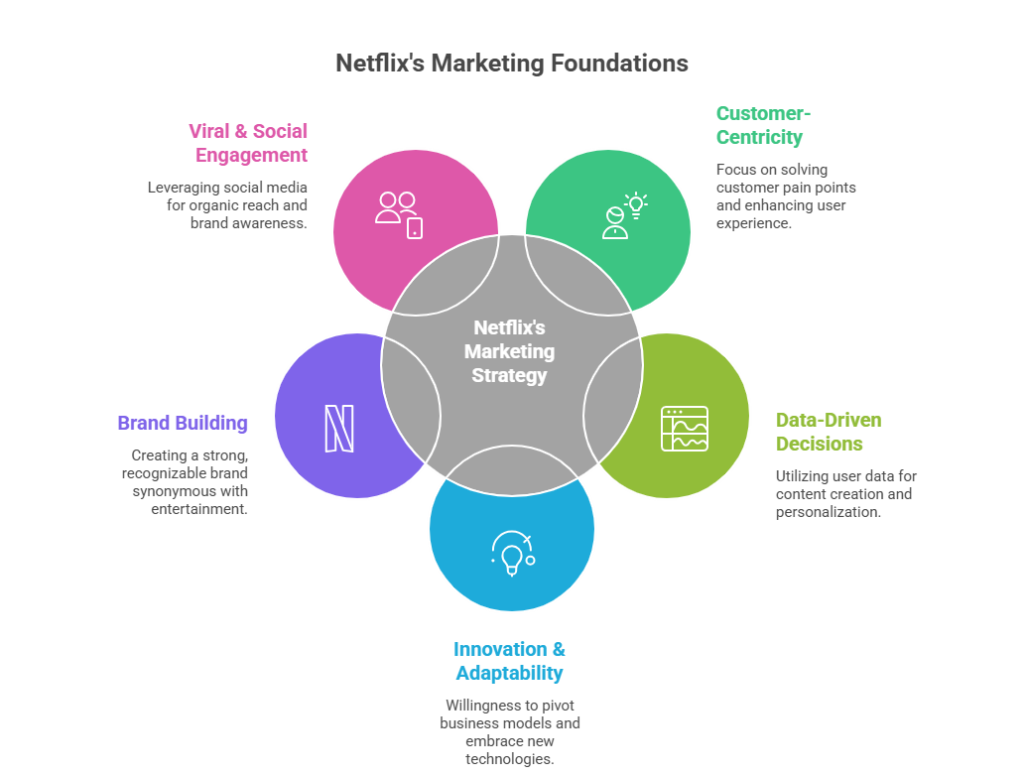
They also utilize what some industry experts call the ‘Netflix Effect. This is when a show or movie experiences tremendous popularity as a result of being added to Netflix. Shows like Suits and The Flash came to international recognition years after they ended their original cable runs as a result of the way Netflix suggested their content to the appropriate viewers.
Facing the Future: Competition and Innovation
The “Streaming Wars” are now in full swing as we look ahead to 2026. With Disney+, HBO Max, and Amazon Prime competing for viewers, Netflix has needed to change, yet again. They are now offering a low-cost ad-supported subscription. In addition, they are now going to offer live sports, as well as Netflix Games.
With the addition of NFL games to their platform and mobile games on their app, Netflix is making a play to be a “one stop shop” for digital entertainment. Their advertisement is now shifting from “Watch Movies” to “Be Entertained”, indicative of a change in focus for a streaming platform.
Conclusion: Lessons from the Netflix Playbook
The evolution of Netflix from a mail-order DVD rental service to a worldwide streaming service demonstrates the benefits of flexibility and dynamic thinking. The success of this business model was not the advancement of technology, but the refinement of the business model.
Key Takeaways for Businesses:
- Focus on Friction: Netflix succeeded by identifying and removing the “pain points” of the rental industry (late fees).
- Bet on the Future: Don’t be afraid to cannibalize your own successful business model if a more innovative one is on the horizon.
- Data Over Guesswork: Use customer data not just to track behavior, but to predict and personalize the entire user experience.
- Build Your Own Moat: In a competitive market, owning your product (original content) is the only way to ensure long-term survival.
Netflix revolutionized the television industry and inspired new models for storytelling around the globe. By prioritizing the customer and remaining ahead of the curve, they have redefined the entertainment industry, “Tudum” at a time.
👨💼 Author: BBAProject Editorial Team
✍️ The BBAProject Editorial Team comprises business graduates and educators dedicated to creating practical, syllabus-based learning resources for BBA students.
⚠️ Please Note: Articles published on BBAProject.in are well-researched and regularly updated. However, students are advised to verify data, statistics, or references before using them for academic submissions.