
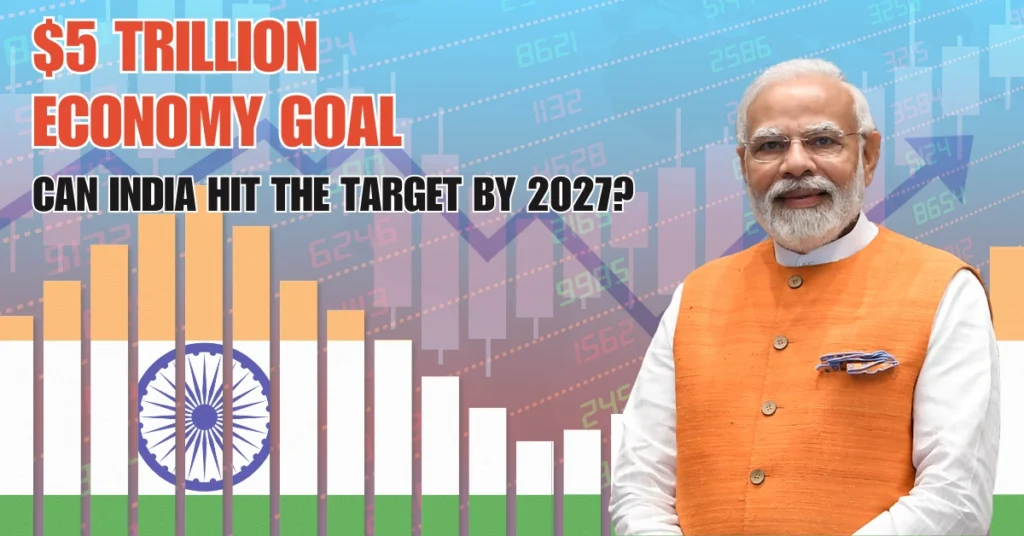
India’s $5 trillion economy by the mid-2020s has become the central theme in the country’s developmental story. India is the fastest growing major economy in the world and is at a major turning point where structural reforms, digital advancements and demographic dividend are set to improve India’s position in the world. Can the “Elephant” dance to a $5 trillion economy by 2027, is the question on every global investor’s mind.
The $5 trillion GDP vision is a growth projection indicating India’s envisaged transformation into a global economic leader.The revised GDP growth estimates, the national accounts base year shift to 2022-23, and the fast-growing manufacturing sector are the factors that substantiate this vision today, as opposed to it being a political slogan. With the given forecast from the IMF and India’s Chief Economic Advisor (CEA) with an estimated growth rate of 7.1% to 7.4% for the forthcoming fiscal years, the $5 trillion economy goal for India is achievable.
The Mathematical Path to the India’s $5 trillion economy Milstone
Understanding India’s target requires examining the numbers. From the beginning of 2026, India will have an estimated GDP of more than $4 trillion. For India to reach $5 trillion and approximately $5.5 trillion by the end of 2027 or beginning of 2028 (FY28), the country needs to maintain double-digit growth. This growth needs to include a combination of real GDP growth and inflation.
| Indicator | Current Projection (2025-26) | Target for 2027-28 |
| Real GDP Growth | 7.4% – 7.6% | 7.0%+ (Consistent) |
| Nominal GDP Size | ~$4.2 Trillion | $5.0 Trillion |
| Global Rank | 5th Largest | 3rd Largest (Projected) |
| Key Driver | Digital Public Infrastructure | Manufacturing & Exports |
The recent change of the GDP base year has shed light on India’s structure. This change reflects the growing gig economy, the formalization of the GST, and the growing Unified Payments Interface (UPI) and captures the massive scale of these developments. These are the engines propelling India to reach its $5 trillion goal.
1. Manufacturing and the “China Plus One” Strategy
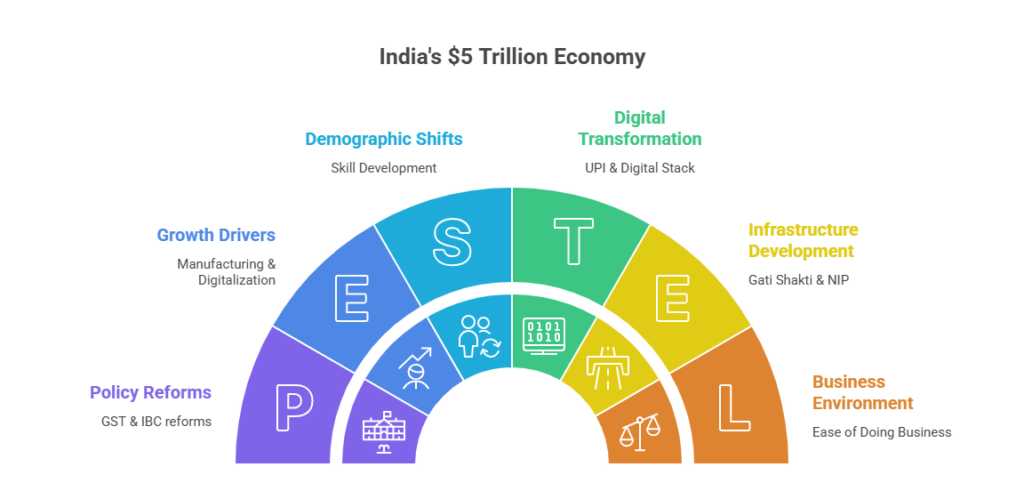
A critical element of the story of India’s aspiration of a $5 trillion economy is the “Make In India” Initiative 2.0. As global supply chains look for alternatives to China, India is emerging as a potential manufacturing destination. The Production Linked Incentives (PLI) schemes for electronics, pharmaceuticals, green energy, and 11 other sectors are predicted to add several billion to India’s GDP.
The success of Apple relocating its iPhone production to India and the burgeoning local semiconductor ecosystems is a precursor of things to come, and is not a standalone success. It is the first of many success to come. It is the first of many success to come, and more will come, as it will further stimulate India and the local ecosystems. Manufacturing is anticipated to contribute more to India’s GDP by 2027. This will help close the gap between the services-dominated economy and balanced industrial economy.
Another key factor supporting this transformation is the rapid improvement in India’s infrastructure and logistics network. Massive investments in highways, freight corridors, ports, and digital infrastructure are making manufacturing and supply chain operations more efficient and cost-effective. Government initiatives such as industrial corridors, smart cities, and dedicated manufacturing zones are attracting both domestic and foreign investors. As infrastructure continues to improve, India will become an even more competitive destination for global manufacturers looking for scale, stability, and long-term growth opportunities.
2. Digital Public Infrastructure: The Growth Multiplier
India’s transformation and progress in the digital space has provided it with a unique competitive advantage. The India Stack comprising of Aadhar, UPI, and ONDC has achieved what has taken other countries 50 years, and done so in a mere 10 years. This has helped digitize the economy and formalized many previously unbanked Indians by reducing leakages in the government subsidy programs, and thus brought them into the formal economy and the digitized economy.
Within the parameters of the goal of a $5 trillion economy, broad gains attributed to the influx of the digital economy are similar across all sectors. Reportedly, the economy is experiencing approximately a 0.5% – 1% increase in GDP each year as a result of digital payment acceptance by small street vendors, along with other productivity-enhancing technologies, including AI-optimized farming tech. The gains are similar with regard to the digital economy tailored to specific sectors. Digital payment acceptance by small street vendors and AI-enhanced farming tech, along with other productivity-enhancing technologies, are likely to yield similar returns across all sectors.
3. Infrastructure: Building the $5 Trillion Foundation
A $5 trillion economy cannot be achieved with 19th-century infrastructure. The Gati Shakti National Master Plan and the National Infrastructure Pipeline (NIP) are designed to overcome this constraint. Improved logistics, 10% of GDP instead of the 14% of GDP in other countries with comparable infrastructure, is a result of the construction of 10,000 km of highways, modernized railways with Vande Bharat trains, and increased capacity at ports. Improved logistics compliment greater infrastructure reaching the global demand for trade as India’s exports eastern hemisphere.
The global average for trade is 8% of GDP. Improved infrastructure and higher trade are critical to achieving the goal of India’s $5 trillion economy.
4. The Demographic Dividend: A Double-Edged Sword
India has the world’s largest youthful population. At a median age of 28, the nation has the largest potential workforce. The demographic dividend is an economic prospect for the $5 trillion target, assuming the youthful population has the adequate qualifications. The ‘Skill India’ mission coupled with the focus shift to vocational trainings is an attempt to avert a demographic disaster.
The rapidly growing middle class of India is also developing a large internal market for consumption. By 2027, India is projected to have one of the largest consumer market in the world, making India less dependent on outside economic shocks and making it internally self sustaining.
5. Challenges on the Horizon: Inflation and Global Headwinds
There is a large degree of pessimism on the road to achieving the $5 trillion target. Geopolitical tensions, unpredictable prices of crude oil, and global inflation are major threats. As a large energy importer, India is vulnerable to worsening current account deficit and depreciating Rupee due to increased oil prices.
The unbalance of income and rural suffering will lead to the demise of sustainable growth in the long run. Inclusive growth will allow India to realize its $5 trillion dream. Ensuring that the growth of GDP benefits the lowest of the low will complete the picture.
How AI Is Changing Business Operations in 2026: From Hype to Real-World Impact
Conclusion: Is 2027 the Magic Year?
There is a growing consensus among economists that the question of achieving a $5 trillion economy is now a matter of when and not if. 2027 remains the target, and the structural foundations being laid today indicate that, despite global headwinds, there may be a delay, but the tilt is irreversible.
India becoming the third-largest economy in the world is not simply a number, but is end reclaiming the position India holds in world trade. The $5 trillion economy goal is the first step in a long journey of transforming India to a Viksit Bharat (Developed India) by 2047.
Exploring Business Economics Principles to Boost Profitability
👨💼 Author: BBAProject Editorial Team
✍️ The BBAProject Editorial Team comprises business graduates and educators dedicated to creating practical, syllabus-based learning resources for BBA students.
⚠️ Please Note: Articles published on BBAProject.in are well-researched and regularly updated. However, students are advised to verify data, statistics, or references before using them for academic submissions.