
Introduction: Why Corporate Social Responsibility Matters More Than Ever
Ask business students and young managers today what distinguishes an average company from a great or respected one, the response will range beyond profits or market share. So, the discussion is an ever growing one about Corporate Social Responsibility (CSR) and sustainability. As a BBA lecturer, I have seen that students often tend to look at CSR as a ‘theory-laden’ topic – atleast that is the impression with which they walk in. But once they see the implications in the real world, it is one of the most practical areas of management learning.
In a nutshell, Corporate Social Responsibility is not something that you just decide to do for the sake of good publicity or fulfilling requirement. Done right, it is a growth engine — building brand trust, enhancing employee engagement, mitigating long-term risk and creating new business opportunities. This article examines what is corporate social responsibility, its history, as well as examples of corporate social responsibilities (CSR) to illustrate that CSR cannot only transform public perception but also affect the bottom line.
The discussion is written especially for BBA, MBA, and management learners, but it is equally useful for professionals who want to understand CSR beyond textbooks. The language is practical, the tone is guiding and friendly, and every section focuses on clarity and application rather than theory alone.
What Is Corporate Social Responsibility? A Definition for Clear Understanding
But before we indulge in strategies and results, let us know about the corporate social responsibility meaning.
Corporate Social Responsibility (CSR) is about a company committing to behave ethically, contribute to economic development and improve quality of life for its workforce, its community and even society at large – but not at the expense of pursuing business objectives.
CSR is based on a simple, yet powerful premise: Companies do not function in a vacuum. They rely on society for resources, customers, employees and legitimacy. In the meantime, society in turn expects businesses to act responsibly.
CSR is often explained using four broad dimensions:
| CSR Dimension | Focus Area | Practical Meaning |
| Economic Responsibility | Profitability | Running a financially stable and efficient business |
| Legal Responsibility | Compliance | Following laws, regulations, and standards |
| Ethical Responsibility | Fairness | Doing what is right, even when not legally required |
| Social Responsibility | Contribution | Supporting community, environment, and social welfare |
For students, it’s as important to realize that CSR does not equal giving up the profit. It recalibrates profit-seeking to responsible decision-making; it encourages long-term planning not at the expense of ethical fundamentals but as the wellspring of sustainability.
From Charity to Strategy: The Evolution of CSR
“Currently, CSR was generally perceived initially as synonymous with donations, sponsorships or one-off social initiatives. As useful as these initiatives were, they frequently bore only a superficial relationship to the company’s fundamental business.
Corporate Social Responsibility is a strategic role in the contemporary era. It now integrates with:
Business planning
Supply chain decisions
Human resource policies
Risk management
Brand positioning This change occurred because companies have come to recognize that social and environmental issues — from resource scarcity and climate impact to employee well-being — are directly linked to their long-term performance. Bad practices (in, say, labour relations) lead to high turnover of staff and bad mores (in taking care of the environment) get firms fines and
Today, CSR is about asking one essential question:
“How can a business grow while creating positive impact?”
The Strategic Link Between CSR and Business Growth
One of the biggest misconceptions among students is that CSR is a cost center. In reality, well-designed CSR initiatives often reduce costs, improve efficiency, and strengthen competitive advantage.
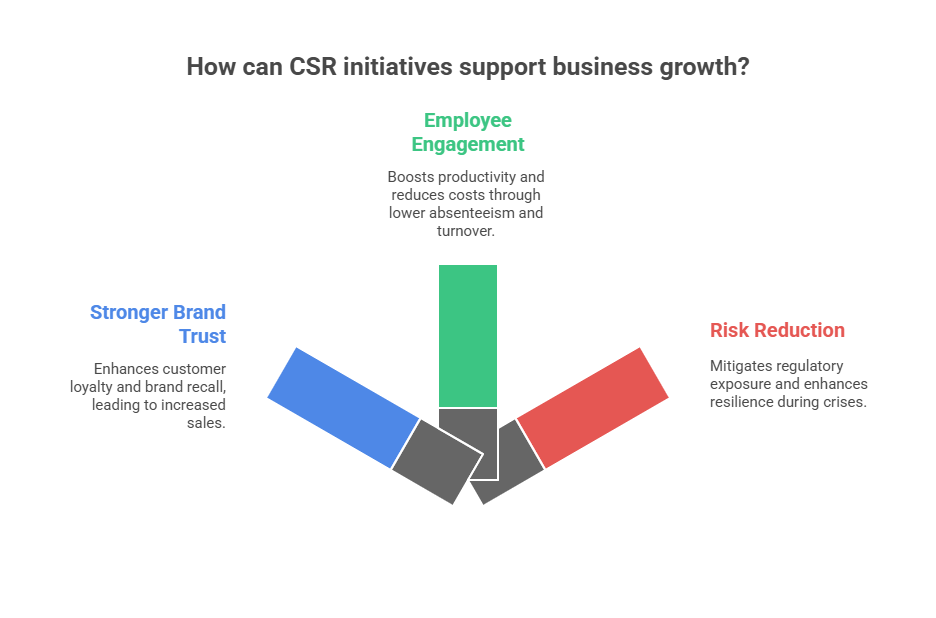
Let us understand how CSR supports business growth through key channels.
1. Stronger Brand Trust and Reputation
Today’s consumers are more informed and aware than ever. They judge businesses by the quality of their products, to be sure, but also by their values. A good company with a conscience works to have:
- Higher customer loyalty
- Better brand recall
- Positive word-of-mouth
Brand trust built is hard for competitors to imitate. This confidence has a natural impact on the net sales of the company.
2. Employee Engagement and Retention
On a HR point of view, CSR is highly considered in employee satisfaction. Workers want to work in a place of pride. When a company is spending its resources on ethical behavior, diversity and inclusion, safety and community development, employees gain a sense of purpose.
Engaged employees show:
- Higher productivity
- Lower absenteeism
- Stronger organizational commitment
These outcomes reduce recruitment and training costs over time.
3. Risk Reduction and Long-Term Stability
CSR is also a tool for managing risk. Environmental responsibility mitigates regulatory exposure. There’s also less potential for scandal and fraud with ethical leadership. Open communication boosts stakeholder trust in a crisis.
In business terms, CSR constitutes resilience — the capacity to withstand and prosper in times of uncertainty.
Sustainability as the Core of Modern CSR
CSR is diverse but “sustainability” has grown to be the spine. Sustainability means to produce for current needs without destroying the capacity of future generations to produce for their needs.
In business, sustainability usually covers three pillars:
| Sustainability Pillar | Business Focus |
| Environmental | Resource efficiency, waste reduction, energy management |
| Social | Employee welfare, community impact, customer safety |
| Economic | Long-term profitability and ethical growth |
A sustainability-driven CSR approach ensures that social initiatives are not temporary but embedded into business operations.
Corporate Social Responsibility Examples That Drive Growth
Knowing theory matters, but csr’s examples bring ideas to life. The examples below are as generic and fabricated (business-wise) as possible without having a branding name of any company mentioned.
Example 1: Skill Development Aligned With Business Needs
A manufacturer recognizes that there are not enough qualified technicians in local areas. Rather than depend solely on outside hiring, it starts a training program for local kids. Here, the participants are trained according to the demands of industry.
Business impact:
- Reduced hiring costs
- Lower employee turnover
- Stronger community relations
This CSR initiative supports both social development and operational efficiency.
Example 2: Sustainable Resource Management
An energy-heavy enterprise sees power bills shooting upward. Based on its CSR approach driven by efficiency, BASF invests in energy-saving processes and measures to cut emissions.
Business impact:
- Lower operational expenses
- Improved compliance with environmental standards
- Enhanced brand image among conscious consumers
This example shows how environmental responsibility can directly improve profitability.
Example 3: Ethical Supply Chain Practices
A company overhauls its supply chain, implements fair labor standards and transparent sourcing policies. Initial supervision costs are higher but the long-term gains are considerable.
Business impact:
- Reduced supply disruptions
- Stronger supplier relationships
- Improved customer trust
Such corporate social responsibility examples highlight how ethical choices support stable growth.
CSR Integration Into Core Business Functions
CSR will only accelerate growth if it is part and parcel of everyday business thinking. Let’s look at how this integration occurs in various big areas of function.
Marketing and CSR
Marketing which is activated via CSR is more about truth and less promotion. Real responsible actions make marketing communication more believable and effective.
Students should note that overstated or misleading CSR claims can harm reputation. Transparency is critical.
Human Resource Management and CSR
In HR, CSR reflects through:
- Fair recruitment practices
- Equal opportunity policies
- Employee wellness programs
This approach benefits organization culture and company performance.
Operations and CSR
Operational CSR includes:
- Efficient resource usage
- Safe working conditions
- Quality-focused processes
Such practices reduce waste, improve productivity, and enhance long-term efficiency.
Measuring the Impact of Corporate Social Responsibility
Students also inquire about what it is like to use mathematics in practice. How do we assess the CSR performance?
CSR impact is measured using both qualitative and quantitative indicators.
| Area | Measurement Indicators |
| Environmental | Energy usage, waste reduction, emissions |
| Social | Employee turnover, training hours, community reach |
| Economic | Cost savings, productivity improvement, risk reduction |
Measurement ensures accountability and helps organizations refine their CSR strategies.
CSR Challenges and Common Mistakes
Corporate Social Responsibility is tremendously advantageous, some of it, however, if executed poorly could restrict the power.
Common challenges include:
- CSR is being addressed as a separate function, and not a corporate-wide responsibility.
- Short-term visibility instead of long-term impact concentration.
- Ignoring stakeholder feedback.
- Unclear purpose and assessment.
From an educational standpoint students need to question CSR efforts rather than take them for granted.
CSR and Ethical Leadership: The Human Element
You can learn a lot from other companies in different industries about how to unify and integrate a sustainable mindset that applies from the top down. Ethical leadership realizes that growth at the expense of society can never be sustainable. They ensure transparency, accountability and fairness at every level of the organization.
Such leadership builds:
- Strong organizational values
- Trust-based stakeholder relationships
- Long-term competitive advantage
CSR, therefore, is as much about people as it is about policies.
Why CSR Is a Career Advantage for Management Students
Corporate Social Responsibility: Definition, Strategy, Implementation in BBA and MBA As a BBA/MBA student the knowledge of what is Corporate Social Responsibility (CSR) is not just theoretical understanding but also you are going to need this knowledge in your career.
There is increasing demand for managers who are able to:
- Balance profitability with responsibility.
- Make ethical decisions under pressure.
- Match business objectives to social impact.
If students are exposed to CSR thinking early, they get a wider managerial orientation.
The Future of Corporate Social Responsibility
In the future, CSR will take on an even more data-centric and stakeholder-oriented approach. Strategic planning will include greater use of sustainability reporting, ethical audits and impact assessment.
Businesses that adapt early will not only survive but lead.
Conclusion: CSR as a Growth-Oriented Business Philosophy
In conclusion, the CSR is not merely good intentions any longer. It’s a practical, strategic and measurable practice that provides the solid support required for business growth if pursued with focus and resolve.
Through learning about the corporate social responsibility definition, exploring real company examples of corporate social responsibility, and connecting it to strategy, students as well as professionals can view CSR as a management tool with potential rather than just an abstract requirement.
As an educator, my advice is simple:
Do not study CSR as a subject to pass exams. Study it as a mindset that shapes responsible leaders and sustainable businesses.
What is the simplest corporate social responsibility definition?
The simplest corporate social responsibility definition is that it refers to a business’s responsibility to operate ethically, contribute to social welfare, protect the environment, and achieve sustainable growth.
2. How does Corporate Social Responsibility help business growth?
CSR supports business growth through enhanced brand trust, risk mitigation, employee engagement, and long-term efficiencies of operation.
Are corporate social responsibility examples only related to charity?
No Examples of corporate social responsibility are ethical supply chain, employee welfare programs, environmental sustainability initiatives and community skill development–not just charity.
Why is CSR important for MBA/BBA students?
CSR builds ethical thinking, strategic awareness, and leadership skills, which are essential for modern management roles.
Can small businesses also practice Corporate Social Responsibility?
Absolutely. CSR is scalable. Sustainable growth Even a small business can implement sustainable practices that fit its size and resources, while also supporting sustainable growth.
👨💼 Author: BBAProject Editorial Team
✍️ The BBAProject Editorial Team comprises business graduates and educators dedicated to creating practical, syllabus-based learning resources for BBA students.
⚠️ Please Note: Articles published on BBAProject.in are well-researched and regularly updated. However, students are advised to verify data, statistics, or references before using them for academic submissions.