
In the bustling urban landscapes of India, a silent revolution has completed its takeover. It’s not a political shift or a technological breakthrough in the traditional sense; it’s a psychological one. We call it the “Blinkit Effect.”
As of 2026, the ‘monthly grocery list’ has been replaced. Grocery lists, in most Indian middle class families were critical. But with a 10 minute delivery promise, we see grocery lists replaced with a new explosive consumer behavior. Something that started out being a convenience for the occasionally forgotten pack of milk has been morphed into a fundamental rewiring for the entire Indian civilization of 1.4 billion people.
The New Retail Hierarchy: Q-Commerce Takes the Crown
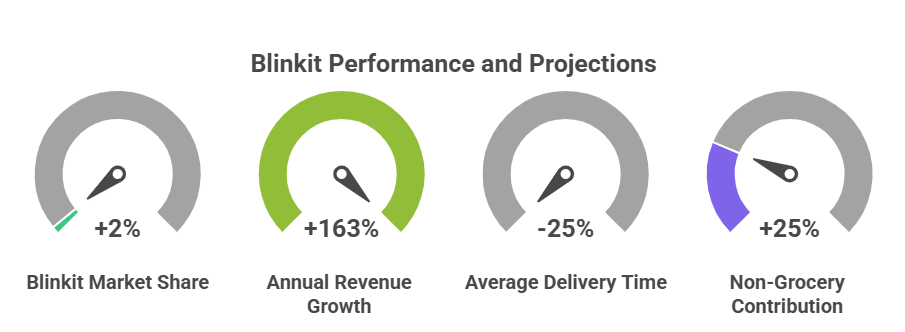
The most recent market data from January 2026 shows Blinkit had the highest market share in the Indian quick commerce (Q-commerce) market, owning 48% of it, followed by Swiggy Instamart (24%) and Zepto (22%).
| Metric | 2024 Performance | 2026 Projections/Status |
| Blinkit Market Share | 46% | 48% |
| Annual Revenue Growth | ~80% | 163% (YoY) |
| Average Delivery Time | 12-15 Minutes | 9-11 Minutes |
| Non-Grocery Contribution | <10% | 35% (Electronics, Beauty, Fashion) |
The most surprising casualty is not the local Kirana store, as most predicted, but traditional e-commerce giants. Q-commerce in early 2026 is reported to be ”trampling on the toes” of Amazon and Flipkart as customers would rather order iPhone and high-end cosmetics from Q-commerce and get it delivered in 10 minutes rather than wait 24-48 hours for it to get delivered from traditional platforms.
Psychological Shift 1: The Death of the “Planned Purchase”
Indian invented consumer rituals like the ‘Monthly Ration’. They planned out their purchases and then reaped the rewards by buying staples in bulk.
This is no longer the case. The Blinkit Effect is a psychological change from ‘Stocking up’ to ‘Summoning’.
The psychology behind ‘ordering small’ is no longer a barrier. The cost of delivery is less than the cost of gas to drive to the store. When the delivery cost is less than the gas cost the consumer no longer considers it.
What she refers to as Micro-Consumption is the purchasing model of urban households. Buying 1 kg of flour five times a month is Micro-Consumption. The previous model of buying 5 kg of flour once a month is dead.
This has led to a reduction in household waste but a massive increase in ‘impulse frequency.’
5 Brilliant Marketing Strategies behind Zomato’s Remarkable Social Media Marketing
Psychological Shift 2: The 10-Minute Dopamine Loop
The Blinkit Effect is based on the Instant Gratification Loop. The ’10-minute expectation’ has become the norm of urban life in 2026.
• The Anxiety of Waiting: The psychological stress that people feel as the wait time increases from 24 hours is a well-documented phenomenon. Waiting 24 hours to receive a product is a common example.
If the delivery doesn’t arrive before the tea is done brewing, it feels “late.”
• The Dopamine Hit: The feeling of extreme excitement because of receiving the order creates a huge feeling of pleasure in the brain which is addictive. This is one of the reasons the quick commerce apps have become the most used utility apps in India, even more than social media apps at certain times of the day.
The Kirana Paradox: Survival of the Fastest
The effect on Kirana stores is complicated. Q-commerce have caused over 200,000 petty shops to close down in the last year alone, while others have developed new ways to survive, such as adapting to “dark store” partnerships or moving toward more personal services (interactive, face-to-face services) that apps are unable to provide (high-touch services).
The psychological bond between consumers and the “neighborhood uncle” is still there, however. The trust that used to be in a person is now placed in a GPS tracking system. The “Blinkit Effect” has devalued the relationship. People don’t care who delivers the milk, they only care about speed.
The Netflix Strategy: How a DVD Rental Store Became a Global Streaming Giant
Beyond the Kitchen: The “Everything Now” Economy
In mid 2026, Blinkit and others will offer much more than groceries. The “Blinkit Effect” will change:
- 1. Electronics: Looking for a MacBook charger or a PlayStation controller? It will be there in 12 minutes.
- 2 Fashion: Need a certain shade of lipstick for a party or forgot a tie for a meeting? Q-commerce is the new mall.
- 3 Pharmacy: A large part of late-night orders focuses on emergency medicine and wellness products.
The Hidden Cost: The Safety vs. Speed Debate
The “Blinkit Effect” will have its first major obstacle with laws and regulations in India. In 2026, the Indian government began to restrict marks for 10-minute marketing as it relates to the safety of the rider. However, the consumer psychology is already established. Even when an app states it will take 20 minutes, consumer psychology will still suggest that it only takes 10.
Conclusion: A Nation Rewired
The “Blinkit Effect” is a success from a business standpoint, but more importantly, it is a reflection of the evolving Indian consumer. In 2026, we are more impatient. We have given up the comfort of a fully stocked pantry and have become reliant on the convenience of technology.
It is clear that as quick commerce approaches 70% for certain categories of urban retail sales, the 10-minute delivery is not simply a service, it is a way of life, a psychological necessity and the driving force of the Indian economy.
References:
- S&P Global Market Intelligence, “Blinkit to drive Eternal’s revenue surge,” Jan 2026.
- Economic Times, “Quick commerce march trampling on ecommerce toes,” Jan 2026.
- AICPDF Report on Kirana Store Closures, Oct 2025.
- UserTestPro, “The 10-minute expectation: Rewiring Indian Psychology,” Feb 2026.