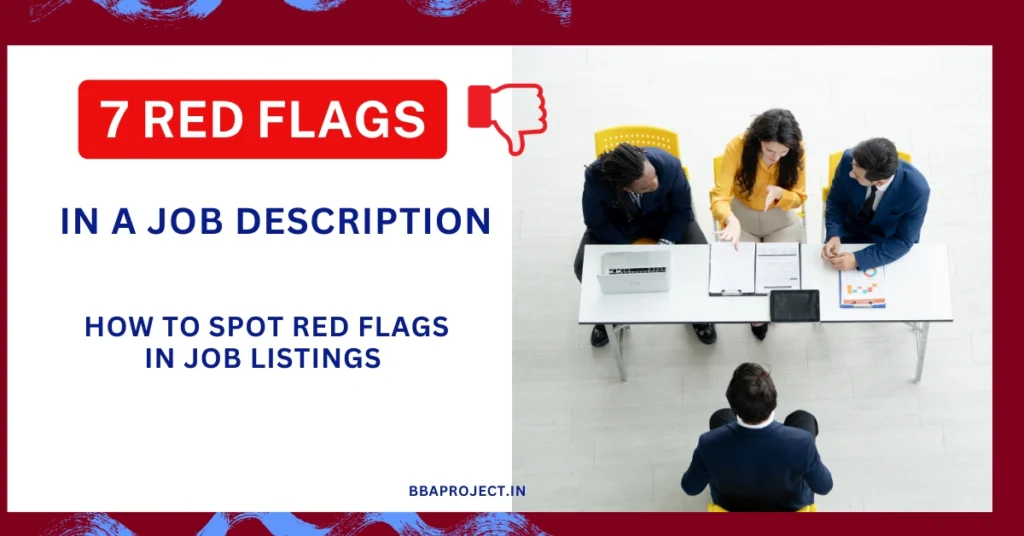
In 2026, the job market will require a healthy amount of professional skepticism. Though the overall economy appears to be performing well, with nearly 92% of companies saying that they are hiring, there are still some major red flags to watch out for. New reports show that 55% of the same companies are preparing to lose a significant amount of employees.
In this case, the so-called ”great turnover” refers to companies hiring aggressively for transformation roles while getting rid of employees in other positions. A good job description takes all of this into account. Instead of focusing too much on tasks, a job description outlines the overall state of an organization and the relationships within it.
Every modern professional must know how to identify corporate speak in toxic job postings, as corporate speak is the thin veil concealing workplace toxicity and firing risk in job postings. Attribution of workplace toxicity and risk of firing to corporate speak is based on the linguistic patterns and structural omissions in job postings. To companies focused on short term ROI, they are focused on optimizing the workforce. The seven red flags below are the most common examples of lack of staffing, ordconomic toxicity, and poor quality job postings anticipated in the 2026 job market.
1. The “AI-Driven Efficiency” Euphemism: A Mask for Financial Instability
AI is the new buzzword in corporate speak for budget cuts, “most companies aren’t honest about their plans to reduce staff and will cite AI as the reason for job cuts.” The reason companies utilize corporate speak job postings is to appease stakeholders, as most stakeholders do not want to hear the honest reason for the lack of hiring.” Job postings focused on AI most often are not hiring. These job postings likely include statements such as: “optimizing headcount through AI automation” and “streamlining legacy processes for maximum ROI.” These companies must be avoided.
When this kind of language starts being used, it likely means that an organization is undergoing a ‘rebalancing’ of sorts. It suggests that the organization views human talent as something more transitional. The potential employee is not being viewed in the context of what they creatively and intellectually contribute to the organization long-term; instead, they are likely being hired to support the full automation of the department in which the position being hired for exists. Furthermore, this focus on ‘efficiency’ is often a forerunner to ‘quiet layoffs’ of roles where one or more positions are eliminated, and the remaining staff are expected to take on the full responsibilities of those who are gone under the rhetoric of ‘technological empowerment.’ When a job description seems to read more like a software module’s technical specification than something for a human being, it is signifying that the organization views its employees as a temporary means to reach a fully automated, outsourced, low-cost future.
2. The “Rockstar” and “Ninja” Resurrection: Glorifying Burnout
The use of hyperbolic, non-discipline-specific job titles such as “Rockstar Developer” and “Marketing Ninja” is evidence of a toxic culture. A company looking for someone who “thrives in a high-pressure, fast-paced environment” is looking, not for a competent person, but for a sacrifice of their health for the company.
A toxic workplace would describe the lack of professional boundaries in framing jargon. A “Rockstar” is someone who is expected to work beyond standard hours and is not compensated for it. A “Ninja” is someone who works “invisibly” and is expected to fix the organization’s systemic problems during unrecognized and unsupported off-hours. The return of this “hustle culture” lexicon is especially concerning given forecasted global burnout levels for 2026. This lexicon underscores an emphasis on personal “grit” and “intensity” in lieu of organizational safety and collective well-being. A job posting that privileges these attributes over technical skills and professional growth is likely to experience frequent staff turnover due to a lack of managerial fundamental support.
3. Vague Duties and the “Many Hats” Trap: Sign of Organizational Chaos
Lack of role clarity is a consequence of an organization that is either failing or financially struggling. The more a job description contains phrases like “wear many hats,” “no two days are the same,” or the all-encompassing “other duties as assigned,” the greater the organizational chaos and understaffing.
When businesses say they want employees to be “flexible,” they often mean they want to operate at a lower capacity and want employees to take on the work that others have left. Bottom line: it shows the company is struggling financially. It also shows that the company does not have a specific need to hire someone. Instead, they need to hire someone to do everything. This is often referred to as “catch-all” hiring. This leads to vague and unclear expectations, so performance reviews have little meaning, and employees know they are unlikely to get promoted. This often leads to high turnover.
The AI Gatekeeper: How Algorithms are Deciding Your Next Job in 2026
4. The “Family” Culture and Blurred Boundaries: Emotional Manipulation
One of the most clear-cut and stimulating of the red flags is the statement, “We are a family.” In a professional setting, the use of such terms is almost always a way of justifying unreasonable requests and of enforcing intimacy. Remarkably, families do not fire members when the performance evaluations are poor.
Most of the time, when a JD talks about family values and loyalty, it means they want you to work longer and sacrifice more of your mental and emotional well-being to do what’s best for the company. This goes hand in hand with a supposed need for flexible schedules. In today’s world, this means the company expects you to work after contracted hours. Good companies know how to put a cap on professional boundaries. They use emotional manipulation to keep others from ‘working for free’.
5. Missing Compensation and “Commensurate” Pay: Opacity and Undervaluation
Companies have become so good at disguising a lack of pay transparency that in 2026, we see the same old phrases like ‘commensurate with your experience’ and ‘competitive salary’ printed on websites. When over half of employees expect layoffs to increase, the lack of pay transparency is a clear sign that the company is either underfunded, or pay is inequitable. If a business won’t say how much they pay for a job, it probably means they want to pay as little as possible for job seekers.
A company should have a consistent pay structure, and if they don’t, it’s probably not a good sign. Companies that have no structured pay usually have no structured leadership and company values. If a company won’t say how much a job pays, then it’s probably a sign they have serious money and pay structure issues and don’t want to be transparent to job seekers.
6. The “Urgent Hire” for Non-Critical Roles: A Sign of Mass Exodus
Rapid and planned business growth is completely different from desperate attempts to stop a losing business. If a middle management or administrative position is advertised as an “Urgent Hire” or “Immediately Required” role, the potential candidates have to ask, why is this role so important?
When I say something is “urgent” I mean management has quit, or worse, the whole team has jumped ship. Zane, unplanned, mass, team exits are the endpoint. That’s how bad it is in the company. If the company is trying to rush the hiring process, they are trying to bring someone on before the applicants can do any real, in depth research, like reading company employee reviews, or looking for patterns in exiting employees. Leaving on bad terms is bad, but it’s worse for the departing employees to be in the company. They are not “solving” anything systematically. They are changing culture in the company to be worse.
7. The “Ghost Job” and Constant Re-Posting: Prioritizing Perception Over People
For months, “Ghost Jobs” are unfilled postings. Having the job description out there becomes a filled job posting to employees and potential employees. All of these things are unexplainably bad. They are collecting potential employees for a “rainy day.” Because of the workload, employers don’t have active hiring for the company. Companies are not growing, or they have separate, secret hiring freezes. They put job postings for a “rainy day.” Companies have active job postings for other purposes than finding employees. They have active job postings for the appearance of growth. If there are active job openings but it’s a hiring freeze, it shows an active, healthy business.
Job postings that have been live for months, or that are reposted frequently, can mean one of two things. The most common reason is that the company is absurdly unrealistic in what they are looking for; a sure sign of unhealthy micromanagement. However, it also may mean that the company is not actually committed to the hiring process. Setting applications for the latter, is a sure sign of value-marketing; that they care more about the appearance of hiring than actually bringing the necessary people on board.
Summary of Red Flags and Their Hidden Meanings
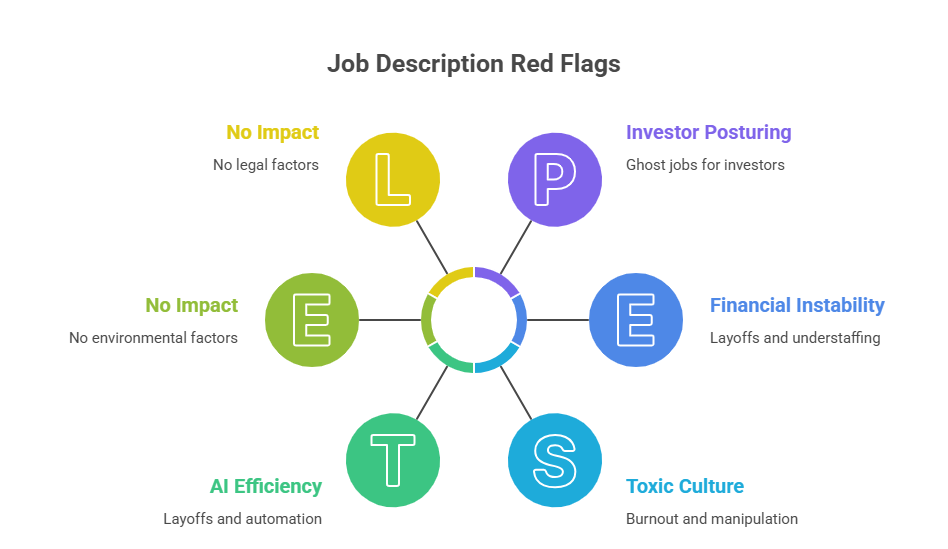
| Red Flag | What the JD Says | What it Actually Means | Indicator of |
| The AI Mask | “Optimizing for AI efficiency” | We are planning layoffs and you’re the bridge to a cheaper future. | Layoffs/Financial Instability |
| The Martyr Call | “Rockstar,” “Ninja,” “Hustle” | We expect 80-hour weeks with no boundaries or compensation for overtime. | Toxic Culture/Burnout |
| The Chaos Sign | “Wear many hats,” “Vague duties” | We are severely understaffed, disorganized, and you will fill all the gaps. | Financial Instability/Toxicity |
| The Manipulation | “We are a family” | We will use emotional guilt to make you work for free and sacrifice personal time. | Toxic Culture/Poor Boundaries |
| The Pay Gap | “Competitive salary” | We want to pay you as little as possible and lack transparency in our finances. | Financial Instability/Inequity |
| The Desperation | “Urgent hire,” “Immediate start” | Everyone else just quit without notice; we need a quick, temporary fix. | Toxic Culture/High Turnover |
| The Ghosting | Constant re-posting | We aren’t hiring; we’re just posturing for investors or collecting data. | Financial Instability/Mismanagement |
Quiet Quitting: The Gen Z Revolution Redefining HRM in 2026
Conclusion: The Power of Professional Skepticism
In 2026, the ‘Hidden’ Signals present in Job Posting Descriptions will be even more informative than the Job Description. An employer who truly cares about their employees will be clear about what they want from them, what they will be paid, and will honor work and life boundaries. During the ongoing Job Market Turnover, the strongest weapon a job seeker can wield is a healthy level of skepticism. If a job offer does not seem to offer enough and its description looks unreasonable, then chances are high it is. During these times of Corporate Rebalancing, the “best” thing you can do, is not to do anything at all.
References
[1] Resume.org Report Data on 2026 Hiring and Layoff Expectations (via HR Dive).
[2] Monster Survey on Worker Expectations for 2026 Layoffs (via CNBC).
[3] MIT Sloan Research on Toxic Culture as the Top Reason for Employee Attrition (via Forbes).