
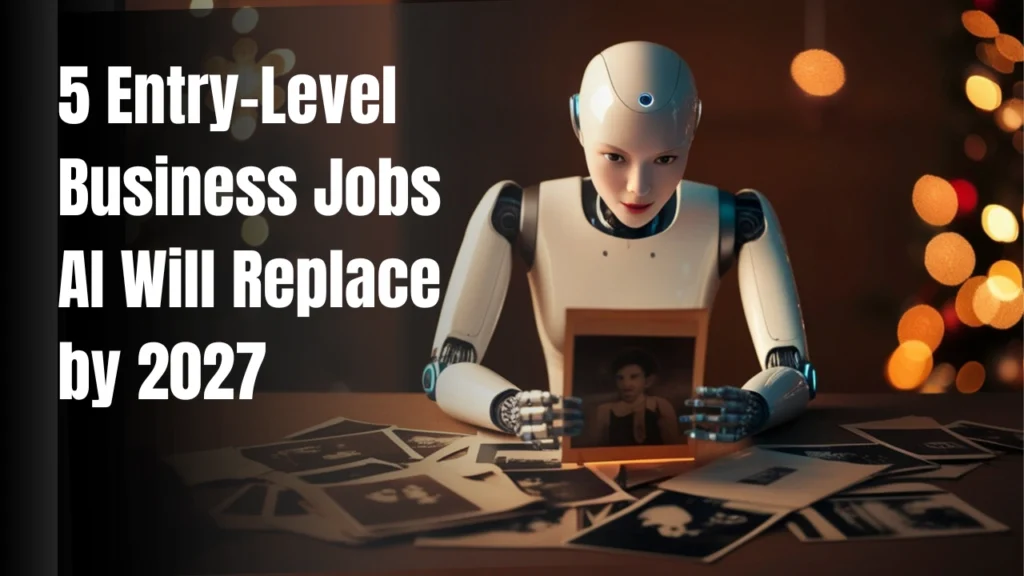
BBA and MBA graduates are facing increased difficulty with the “entry-level” problem. 2026 and 2027 are seeing a business model change in the job market. Goldman Sachs and McKinsey have published reports stating that AI has become a competitor, rather than just a tool. Jobs that AI competes with are known to be the “building blocks” of business careers.
Students and recent graduates should not be in panic mode. Instead, focus should be on acquiring new skills. What follows are the 5 business entry-level jobs that have the highest risk of being automated by 2027, and what you should do to stay ahead.
1. Junior Data Analyst (The Rise of Automated Insights)
In the past, BBA graduates entered the job market by cleaning data in Excel and making simple charts. Now, generative AI can perform data cleaning, run complex regressions, and create visualization dashboards in seconds.
The Risk: Manual data entry and basic reporting positions are being taken over by “Auto-Insights” platforms.
The Shift: From Data Cleaning to Data Storytelling. Learn to analyze AI output through the lens of a strategist. Practice with Tableau or PowerBI along with AI-prompting.
2. Entry-Level HR Coordinator (Automated Recruitment)
HR used to take weeks to scan a stack of CVs and organize several interview rounds. By 2026, AI “Gatekeepers” will take care of 90% of the first screening interview, do sentiment analysis of video interviews and answer questions related to payroll.
• The Threat: Many HR administrative functions and “CV screening” jobs will disappear.
• The Shift: Employee Experience (EX) and Organizational Culture. AI cannot create relationships or navigate office politics. Focus on Conflict, Talent, and AI-centric Human Resource Analytics.
The AI Gatekeeper: How Algorithms are Deciding Your Next Job in 2026
3. Junior Content Marketer & SEO Assistant
If your job involves writing web descriptions, simple blog posts, or social media captioning, you are in luck. AI will do it faster and cheaper. Tools like Jasper and ChatGPT-5 can churn out web pages and blog posts with optimal SEO.
The Threat: Jobs that involve a lot of writing but require little thought.
The Shift: Become an AI Content Orchestrator. Learn to manage AI workflows, concentrate on Brand Strategy, high-end Creative Direction, and Community Building. These are things AI still struggles to do.
4. Accounts Payable/Receivable Clerk
Because finance is usually structured, it’s easy to guess that it would be one of the first to be affected by AI. Incorporating AI into modern invoicing, expense tracking, and fraud detection (99% accuracy) is quickly becoming the norm in fintech.
The Risk: Automated bookkeeping and entry-level accounting tasks.
The Pivot: Financial Planning & Analysis (FP&A). Instead of documenting the past, use AI tools to forecast and advise on future financial activities and investments.
5. Junior Market Research Associate
For entry-level positions, the job of collecting and analyzing survey results and synthesizing reports on market trends would take up to 40 hours a week. AI can now do that, including real-time web crawling, competitor price tracking, and consumer sentiment analysis.
The Risk: Primary research and shallow analysis.
The Pivot: Consumer Psychology and Ethnographic Research. Go behind the numbers and explore the underlying emotions and cultural contexts, the ‘why’ of the data that AI is unable to capture.
How to “Future-Proof” Your Career: The 3-Step Strategy
1 Adopt the “AI-Plus” Mindset: Instead of just saying “Excel” on your resume, say “AI-Augmented Data Analysis.” Demonstrate to potential employers your ability to utilize AI to accomplish the workload of three individuals.
2. Further develop your soft skills: With everything in society becoming automated, emotional intelligence, or EI, will be one of the most important skills that employees will be required to have. Negotiation, leadership, and empathy skills will be very important to have and cannot be automated.
3. Prompt Engineering: Talking to AI will become a vital business skill for all sectors. Whether marketing, finance, or HR, the ability to prompt AI will be as important as being able to type.
Frequently Asked Questions (FAQs)
Will AI completely stop hiring for entry-level roles?
No. Companies will still hire freshers, but they will hire fewer of them. The ones they do hire will be expected to manage AI tools rather than doing the manual work themselves.
Is a BBA degree still worth it in 2027?
Yes, but only if the curriculum evolves. A degree that focuses only on theory is risky. Look for programs (or supplement your degree) with Business Analytics, Digital Transformation, and AI Strategy.
Which business sector is safest from AI?
Roles that require high levels of human interaction, ethics, and complex negotiation are the safest. This includes Strategic Consulting, High-Stakes Sales, and Change Management.
Should I learn coding to save my business career?
You don’t need to be a software engineer, but having a “technical literacy” (understanding how APIs, LLMs, and Data Lakes work) is highly recommended for any business leader in 2027.
What is the single most important skill to learn right now?
Adaptability. The ability to unlearn old methods and quickly master new AI tools every 6 months is the only way to stay employed in the next decade.
For more career guides and BBA study resources, visit bbaproject.in.
👨💼 Author: BBAProject Editorial Team
✍️ The BBAProject Editorial Team comprises business graduates and educators dedicated to creating practical, syllabus-based learning resources for BBA students.
⚠️ Please Note: Articles published on BBAProject.in are well-researched and regularly updated. However, students are advised to verify data, statistics, or references before using them for academic submissions.